What is a Hydraulic Truck Tippler? Introduction to Bulk Material Handling
A hydraulic truck tippler is specialized industrial equipment designed to lift and tip loaded trucks, allowing bulk materials to be efficiently unloaded without manual labor. This mechanized process revolutionizes material handling operations by:
- Reducing unloading time: What once took hours can now be completed in minutes
- Lowering labor costs: Minimal operator involvement reduces workforce requirements
- Improving safety: Eliminates workers climbing trucks or operating manual equipment
- Protecting truck integrity: Controlled hydraulic operation prevents shock loads and damage
- Increasing throughput: Standardized operations mean consistent, rapid material handling
Industries that rely on truck tipplers include mining, aggregate processing, waste management, construction, agriculture, and chemical manufacturing. JEHEL’s hydraulic truck tipplers have been engineered to meet the demanding needs of these sectors, offering capacities from 40 tons to 100 tons with platform sizes ranging from 8.5 meters to 18 meters.
How Does a Truck Tippler Mechanism Work? The Basic Principle
The fundamental operation of a truck tippler mechanism relies on controlled hydraulic pressure to lift a truck platform. Here’s the basic principle:
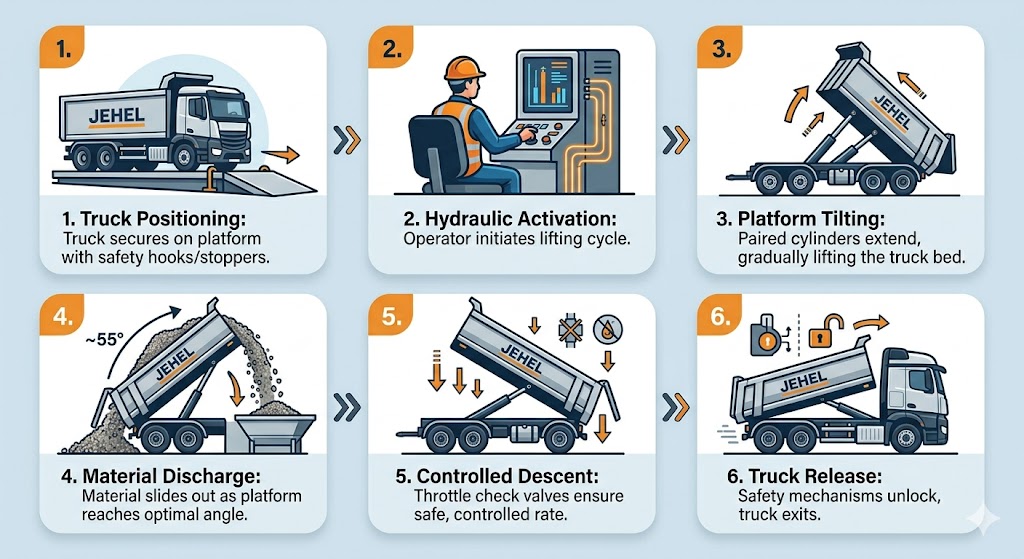
- Truck positioning: The truck is driven onto the loading platform and secured using safety mechanisms
- Hydraulic activation: An operator initiates the lifting cycle using a control panel
- Platform tilting: Paired hydraulic cylinders extend, gradually lifting the truck bed
- Material discharge: As the platform reaches the optimal angle (up to 55°), material slides out
- Controlled descent: Once empty, throttle control valves ensure the platform lowers at a safe, controlled rate
- Truck release: Safety mechanisms automatically unlock, allowing the truck to exit
This entire process is automated and can be completed in as little as 3-5 minutes, depending on the material being unloaded and the truck’s weight distribution.
Understanding the Hydraulic Truck Tippler System: How All Components Work Together
At the heart of every hydraulic truck tippler system lies a sophisticated hydraulic circuit. This circuit is the “nervous system” of the machine, controlling every movement with precision. The hydraulic circuit accomplishes this through the coordinated action of multiple components working in perfect harmony.
Think of the hydraulic circuit like a blood circulatory system: the pump (heart) moves hydraulic fluid through carefully designed pathways, control valves (arteries and capillaries) direct flow to specific locations, and relief valves ensure pressure never becomes dangerous. Understanding this circuit is key to recognizing how modern truck tippler mechanisms achieve their remarkable efficiency and safety.
Key Components of a Hydraulic Truck Tippler System – Detailed Explanation
1. Electric Motor – The Prime Mover
The electric motor is the fundamental power source driving the entire hydraulic truck tippler system. Specifications include:
- Power output: Typically 15-25 kW depending on tippler capacity
- Operating voltage: 3-phase 440V AC (India standard) or 380V (International)
- Speed: Optimized to deliver consistent flow to the hydraulic pump
- Function: Converts electrical energy into mechanical rotation
The motor’s output is directly coupled to the tandem pump, which uses this rotational energy to move hydraulic fluid through the system. Motor efficiency is critical—a well-maintained motor can run for 20+ years without significant degradation.
2. Tandem Pump – The Hydraulic Heart
The tandem pump is arguably the most critical component in a truck tippler mechanism. This specialized pump operates differently from standard pumps:
- Dual-section design: Contains two pump sections operating simultaneously
- Consistent pressure: Maintains constant pressure throughout the lifting cycle
- Flow rate: Delivers 40-80 liters per minute (LPM) depending on application
- Operating pressure: Typically 200-250 bar (2900-3600 PSI)
The tandem pump ensures smooth, predictable operation. Unlike gear pumps that pulsate, the tandem pump provides steady flow, resulting in smoother platform lifting and better control during the descent phase.
3. Gate Valve – Safety Isolation Device
Located between the hydraulic tank and the pump, the gate valve serves as a critical safety feature:
- Purpose: Isolates the pump from the system during maintenance
- Material: Heavy-duty brass or ductile iron construction
- Critical rule: Must be opened before starting the pump (operating a pump against a closed gate valve can cause catastrophic damage)
- Indicator: Visual position indicator showing open/closed status
Technicians must always verify the gate valve is open before starting operations. This simple check prevents expensive pump damage and potential safety hazards.
4. Pressure Relief Valve (PRV) – System Protector
The pressure relief valve is an essential safety device that protects the entire hydraulic truck tippler system from dangerous over-pressurization:
- Function: Maintains maximum system pressure at a preset level
- Typical setting: 200-250 bar, adjustable based on system requirements
- Action: Opens automatically when pressure exceeds the set point, releasing excess fluid back to tank
- Location: Positioned between the pressure line and tank line
- Sound indicator: A hissing sound indicates the PRV is actively protecting the system
Without a functioning PRV, sudden pressure spikes (often caused by load shifts or rapid directional changes) could rupture hoses, damage cylinders, or cause catastrophic system failure. The PRV is literally a lifesaver.
5. Directional Control Valve (DCV) – Movement Director
The directional control valve is the “brain” of the truck tippler mechanism, orchestrating all platform movements:
- Type: Solenoid-operated, 4/3 proportional directional control valve
- Function: Routes hydraulic fluid to lift cylinders (up) or allows return flow (down)
- Control: Operated by push-buttons on the control panel or remote control
- Safety feature: Spring-centered to neutral position (neither up nor down)
- Response time: Millisecond-level precision for smooth, controlled movements
Modern truck tipplers use proportional directional control valves that allow variable speed lifting. This means the platform speed can be adjusted during operation, providing better control and adapting to different material densities.
6. Lift Cylinders – The Muscle
The paired lift cylinders are the “muscles” of the truck tippler system:
- Type: Double-acting telescopic hydraulic cylinders
- Bore size: 80-120mm depending on system capacity
- Stroke: 1.5-2.5 meters, allowing full 55° platform tilt
- Force: Capable of lifting 50-100 tons when paired
- Rod material: Hardened and chrome-plated for corrosion resistance and durability
Double-acting cylinders can both extend and retract under hydraulic pressure, providing smooth lifting and controlled lowering. Telescopic design allows compact storage while still delivering the extended length needed for 55° tilting.
7. Throttle Check Valve – Descent Controller
The throttle check valve is specifically designed to manage the descent phase of truck tippler operation:
- Dual function: Allows free flow during lifting, restricts flow during lowering
- Lifting phase: Check ball opens, zero backpressure, fast cylinder extension
- Lowering phase: Backpressure builds, flow is restricted, creating controlled descent
- Adjustment: Descent speed can be fine-tuned without affecting lift speed
- Safety benefit: Prevents free-fall even if the directional control valve fails
Without the throttle check valve, the truck platform would drop dangerously fast during the lowering cycle. The valve’s precise restriction creates a controlled descent rate, protecting both the truck and surrounding personnel.
8. Hydraulic Power Pack – The Control Center
The hydraulic power pack centralizes all hydraulic controls and fluid supply:
- Components inside: Tank, pump, motor, relief valve, filters, and gauges
- Tank capacity: 300-500 liters depending on system size
- Filtration: 10-micron filters maintain fluid cleanliness
- Temperature control: Cooler maintains hydraulic fluid at optimal 40-50°C operating temperature
- Fluid type: ISO VG 46 mineral oil or biodegradable ester-based hydraulic fluid
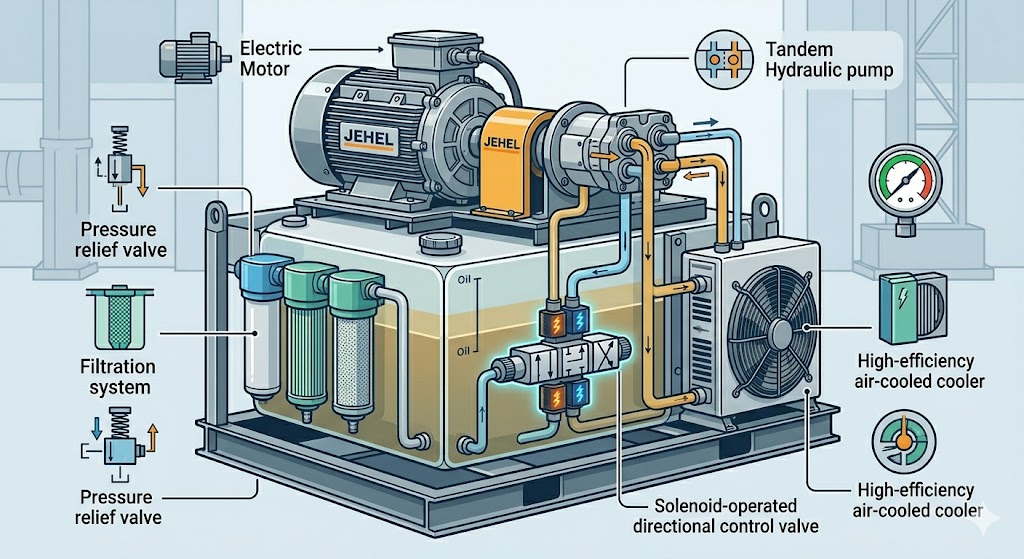
A well-maintained power pack with clean fluid and proper cooling can extend system lifespan to 15-20 years. Regular filter changes every 1000 operating hours is critical.
Truck Tippler Operation: How a Complete Unloading Cycle Works
Let’s walk through a complete hydraulic truck tippler operation step-by-step:
Step 1: Pre-Operation Safety Check (Operator Responsibility)
- Verify truck weight doesn’t exceed system capacity
- Inspect platform and cylinders for visible damage
- Check pressure gauges for normal reading (typically 0 bar at idle)
- Confirm all safety guards are in place
- Ensure no personnel are on or near the platform
Step 2: Truck Positioning and Securing
- Driver positions truck with rear axle on the platform
- Anti-skid chequered plate prevents truck from sliding
- Hook chain arrangement secures the front axle to prevent forward movement
- Retractable back stoppers automatically engage, locking rear wheels
Step 3: Initiating the Lifting Cycle
- Operator presses the “UP” button on the control panel
- Solenoid in the directional control valve energizes
- Pump begins delivering pressurized fluid to the lift cylinders
- Pressure builds smoothly as cylinders begin extending
Step 4: Platform Lifting (Lifting Phase)
- Both lift cylinders extend simultaneously at matched speeds
- Platform gradually tilts from horizontal (0°) toward vertical
- Typical lifting speed: 0.5 meters per minute
- System pressure gradually increases from 50 bar to full 200-250 bar
- Materials begin sliding once platform reaches critical angle (typically 15-20°)
Step 5: Material Discharge
- As platform reaches 45-55° angle, most loose material has discharged
- Operator can adjust platform angle using variable speed control
- For sticky materials, operator may increase angle up to 55° maximum
- Operator holds UP button until all material has discharged
Step 6: Initiating Descent (Lowering Phase)
- Operator releases UP button and presses DOWN button
- Directional control valve shifts, routing cylinder fluid back to tank
- Throttle check valve restricts return flow, creating controlled descent
- Descent speed is preset but can be adjusted during operation
Step 7: Controlled Lowering
- Platform descends smoothly at preset rate (typically 0.3-0.5 m/min)
- Throttle check valve maintains constant backpressure
- System pressure during descent: 30-50 bar (much lower than lifting phase)
- This lower pressure prevents truck damage and extends component lifespan
Step 8: Platform Reset to Horizontal
- Operator continues holding DOWN button until platform is fully horizontal
- Automatic limit switches detect horizontal position
- Solenoid de-energizes, returning directional control valve to neutral
- Pump continues running but fluid circulates through relief valve
Step 9: Truck Release and Exit
- Hook chains automatically release from front axle
- Back stoppers retract, freeing rear wheels
- Driver backs truck off platform at controlled speed
- Platform is now ready for the next truck
Complete cycle time: Typically 3-5 minutes depending on material type and system capacity. This dramatic time savings directly translates to improved facility throughput and reduced operational costs.
Safety Mechanisms in Hydraulic Truck Tipplers: Multiple Layers of Protection
JEHEL’s hydraulic truck tippler systems incorporate multiple redundant safety features to protect both equipment and personnel:
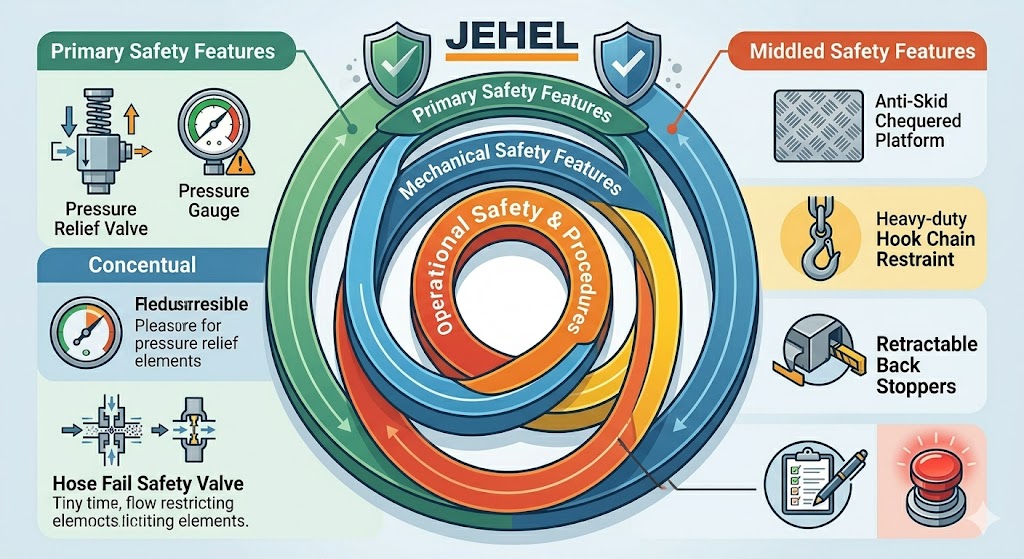
Primary Safety Features
1. Pressure Relief Valve (PRV)
As discussed earlier, the PRV prevents over-pressurization. Even if a control valve sticks or malfunctions, the PRV will automatically release excess pressure, preventing catastrophic system failure.
2. Hose Fail Safety Valve
- Location: On each lift cylinder port
- Function: Instantly seals if a hose ruptures, preventing fluid loss and platform free-fall
- Technology: Pilot-operated check valve technology
- Response time: Milliseconds, faster than gravity
3. Pressure Gauge Monitoring
- Dual pressure gauges allow operator to monitor system pressure
- Abnormal pressure readings indicate potential problems requiring immediate attention
- Digital gauges in modern systems provide audible alarms if pressure exceeds safe limits
Mechanical Safety Features
1. Anti-Skid Chequered Platform
The distinctive checkered pattern on the platform surface prevents truck slippage, even with wet materials or in rainy conditions. This seemingly simple feature prevents serious accidents.
2. Hook Chain Restraint
Heavy-duty chains secure the truck’s front axle, preventing forward movement during tilting. The chains are rated for forces far exceeding the maximum system load.
3. Back Stoppers
Retractable mechanical stops engage the truck’s rear wheels, preventing backward sliding. These can be manual or automatic depending on model.
4. Access Guard Rails
Safety rails prevent unauthorized access to the tilting platform during operation. Yellow and black striping clearly indicates the hazard zone.
Operational Safety Procedures
Pre-Operation Checklist
- Verify truck weight is within system capacity limits
- Inspect platform for cracks or damage
- Check hydraulic fluid level and condition
- Test all control buttons and emergency stops
- Clear the platform and surrounding area of personnel
During Operation
- Operator must remain at control panel during entire cycle
- Continuous observation for unusual sounds, vibrations, or pressure anomalies
- No personnel allowed on platform during operation
- Material must be evenly distributed in truck for balanced lifting
Emergency Stop
All JEHEL systems include an accessible emergency stop button that instantly stops all motion, returning the platform to neutral. In case of power failure, gravity will lower the platform at the rate controlled by the throttle check valve.
JEHEL’s Advanced Hydraulic Truck Tippler Features – Why We Lead the Industry
JEHEL’s hydraulic truck tipplers incorporate several advanced features that set them apart from competitors:
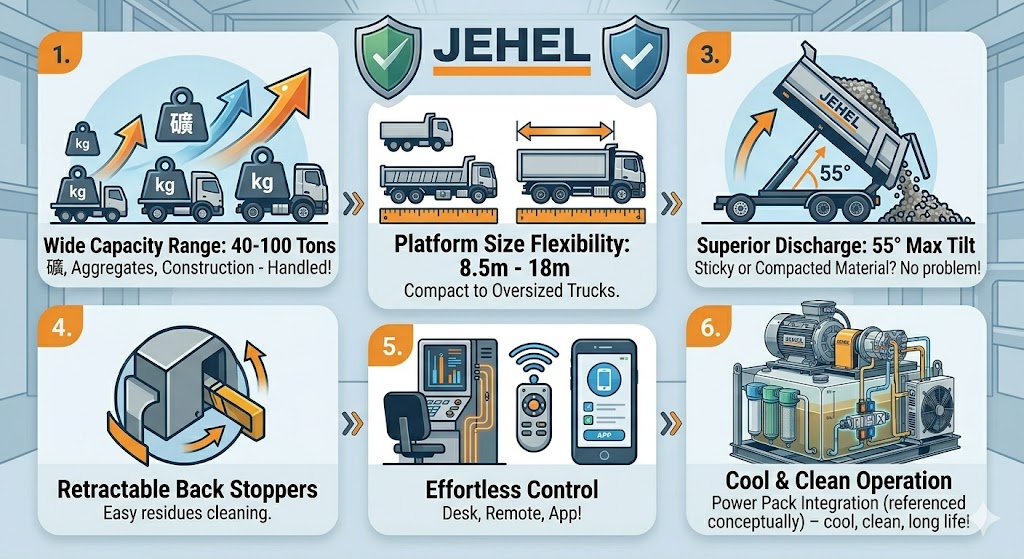
1. Wide Capacity Range
- 40-ton capacity: Perfect for small facilities and mineral applications
- 60-ton capacity: The most common choice for aggregate and mining operations
- 80-ton and 100-ton capacities: For heavy-duty industrial applications
2. Platform Size Flexibility
- 8.5 meters: Compact model for space-limited facilities
- 12 meters: Standard length for most truck models
- 15-18 meters: Extra-long platform for oversized truck trailers
3. Heavy-Duty Lift Cylinders with 55° Tilting Capability
JEHEL’s cylinders are engineered to tilt the platform up to 55°, ensuring complete material discharge even for sticky or compacted loads. This capability is essential for:
- Cement and mineral powders that tend to cake
- Wet materials like clay and soil
- Scrap and demolition waste with irregular shapes
4. Retractable Back Stoppers
Our innovative design allows back stoppers to retract fully, providing complete platform access. This is particularly useful when cleaning sticky residues from the platform.
5. Dual Control Options
- Desk-type control panel: For stationary installations with fixed positions
- Wireless remote control: For improved safety and flexibility
- Smartphone app control: Available on our latest models for modern facility management
6. Power Pack Integration
JEHEL’s custom-designed hydraulic power packs feature:
- Integrated cooling for extended operation in hot climates
- High-capacity filtration maintaining ISO 17/15/12 fluid cleanliness
- Multiple pressure gauges for system monitoring
- Flexible mounting options for different installation configurations
Hydraulic vs Mechanical Truck Tipplers: Choosing the Right Technology
While both hydraulic and mechanical tipplers can unload trucks, they differ significantly in operation, efficiency, and capability:
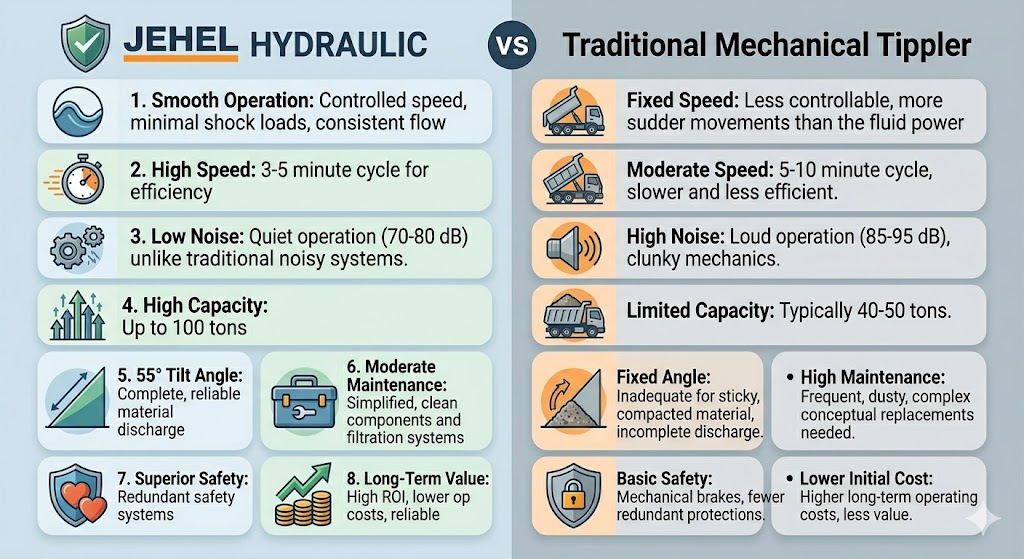
Hydraulic Truck Tipplers (JEHEL Specialty)
- Operation: Smooth, controlled, variable speed
- Speed: 3-5 minutes per cycle
- Noise level: Quiet operation, 70-80 dB
- Capacity: 40-100 tons
- Tilt angle: Up to 55° for complete discharge
- Maintenance: Moderate – annual filter changes and fluid analysis
- Safety: Multiple redundant safety systems
- Cost: Higher initial investment, lower operating costs
- Best for: High-volume operations, sticky materials, different truck types
Mechanical Truck Tipplers
- Operation: Fixed speed, less controllable
- Speed: 5-10 minutes per cycle
- Noise level: Loud operation, 85-95 dB
- Capacity: Limited, typically 40-50 tons
- Tilt angle: Fixed angle, often inadequate for sticky materials
- Maintenance: High – frequent gear and bearing replacement
- Safety: Basic mechanical brakes only
- Cost: Lower initial cost, higher long-term operating costs
- Best for: Low-volume operations, light materials, cost-conscious buyers
For most modern industrial operations, hydraulic systems like JEHEL’s provide superior reliability, efficiency, and safety—making the higher initial investment quickly recoupable through reduced operational costs and improved throughput.
Maintaining Your Hydraulic Truck Tippler System: Best Practices for Longevity
Daily Maintenance Checklist
- Visual inspection for leaks or fluid spillage
- Check hydraulic fluid level (should be at MAX line on tank)
- Test all control buttons for responsive operation
- Inspect platform for cracks or damage
- Verify safety guards and rail integrity
- Listen for unusual noises during operation
Weekly Maintenance
- Clean platform of debris and accumulated material
- Inspect all hoses for cracks or swelling
- Check cylinder rod condition for scoring or corrosion
- Verify pressure readings are within normal range
Monthly Maintenance
- Sample hydraulic fluid for cleanliness analysis
- Inspect all joints and connection points for tightness
- Check cooler fins for blockage or dust accumulation
- Lubricate pivot points and chain mechanisms
Annual Maintenance
- Replace hydraulic fluid filter elements
- Perform complete system pressure test
- Flush entire hydraulic system if fluid analysis indicates contamination
- Inspect and recalibrate pressure relief valve settings
- Professional service of pump and motor
Hydraulic Fluid Management
The quality of hydraulic fluid directly impacts system longevity:
- Recommended fluid: ISO VG 46 mineral oil or equivalent
- Change interval: Every 1000-1500 operating hours
- Target cleanliness: ISO 17/15/12 or better
- Storage: Keep unused fluid in sealed, dry containers
- Disposal: Recycle used fluid according to local environmental regulations
Frequently Asked Questions About Hydraulic Truck Tipplers
Q1: What is the typical lifespan of a hydraulic truck tippler?
A: With proper maintenance, JEHEL’s hydraulic truck tipplers typically last 15-20 years. Some installations have exceeded 25 years of service. Regular fluid changes and component inspections are critical for longevity.
Q2: Can a hydraulic truck tippler handle all truck types?
A: JEHEL offers platform sizes from 8.5 to 18 meters to accommodate different truck lengths. However, the truck weight must not exceed the system’s rated capacity. We recommend consulting with our engineers to ensure compatibility with your specific truck fleet.
Q3: What happens if hydraulic pressure suddenly increases?
A: The pressure relief valve automatically opens, releasing excess pressure back to the tank. This protective mechanism operates continuously and is transparent to the operator. A hissing sound indicates the PRV is working.
Q4: How long does a complete unloading cycle take?
A: A typical cycle (lifting, material discharge, lowering, and platform reset) takes 3-5 minutes. Time varies based on truck weight, material type, and platform size. Sticky materials may require longer cycles or steeper angles.
Q5: What should I do if I notice oil leakage?
A: Stop operations immediately and contact a qualified technician. Oil leakage can indicate:
- Worn hose requiring immediate replacement
- Loose connection needing tightening
- Seal degradation requiring professional service
Q6: Can the system operate in cold climates?
A: Yes, but you’ll need to use winter-grade hydraulic fluid with lower viscosity. Cold hydraulic fluid becomes thick, preventing proper flow. JEHEL can supply appropriate fluids and heating elements for sub-zero operations.
Q7: Is wireless remote control available?
A: Yes, JEHEL offers wireless remote control options for improved safety and operational convenience. Remote controls allow operators to maintain visual oversight of the entire unloading process.
Q8: What’s the difference between single-acting and double-acting cylinders?
A: JEHEL uses double-acting cylinders in all truck tipplers. These cylinders extend and retract under hydraulic pressure, providing smooth lifting and controlled descent. Single-acting cylinders can only extend under pressure, making controlled descent impossible.
Q9: How much power does a hydraulic truck tippler consume?
A: Typical power consumption is 15-25 kW during operation. Since the pump only runs when the system is in use, overall energy costs are minimal. Most facilities operate tipplers 2-3 hours per day, making total daily electricity consumption reasonable.
Q10: What training do operators need?
A: JEHEL provides comprehensive operator training covering:
- Safety procedures and emergency stops
- Daily maintenance checklist
- Troubleshooting common issues
- Equipment limitations and weight capacity verification
Conclusion: Why Understand Truck Tippler Mechanisms
Understanding how a hydraulic truck tippler mechanism works empowers facility managers, operators, and maintenance personnel to make informed decisions about equipment investment, operation, and maintenance. The sophisticated hydraulic truck tippler system represents years of engineering excellence, delivering reliable, efficient, and safe material handling solutions.
JEHEL’s commitment to precision engineering and customer safety means every component—from the tandem pump to the throttle check valve—is designed and tested to the highest standards. Whether you’re upgrading from mechanical systems or establishing a new unloading facility, choosing a proven hydraulic solution from JEHEL ensures decades of dependable service.
Ready to upgrade your material handling operations?
Contact JEHEL today for:
- Custom system design consultation
- Detailed capacity and compatibility analysis
- Site-specific system recommendations
- Financing options and flexible payment terms
- Comprehensive operator training programs
Phone: +91 9051617609 / 595
Email: info@jehel.com
Website: View Our Truck Tippler Products
Related Resources & Product Pages
Truck Tippler Products & Solutions
- Hydraulic Truck Tippler Product Page – Complete specifications and features
- How to Choose the Right Hydraulic Truck Tippler for Your Facility – Selection guide
- Hydraulic vs Mechanical Truck Tipplers: Key Differences Explained – Comparative analysis
- Why JEHEL’s Double-Acting Cylinder Tippler Design Offers Superior Efficiency – Technical deep dive
Related Hydraulic Equipment
- Hydraulic Power Pack – System control center information
- Hydraulic Crane – Complementary lifting equipment
- Stationary Rock Breaker – Material processing equipment
- Orange Peel Grab – Material handling attachment
- Clamshell Grab – Scrap handling solution
Related Blog Articles on Hydraulic Systems
- Hydraulic Power Pack Components and Functionality – Detailed system component guide
- Hydraulic Machines Explained: Definition, Working Principles, Types, and Real-World Applications – Comprehensive hydraulic overview
- Clamshell vs Orange Peel Grabs: Selecting Tools for Bulk Material Handling – Attachment comparison
- How Hydraulic Grabs Outperform Mechanical Grabs in Efficiency and Control – Performance comparison
- When to Repair vs Replace: A Guide for Your Hydraulic Breaker Maintenance – Maintenance decision guide