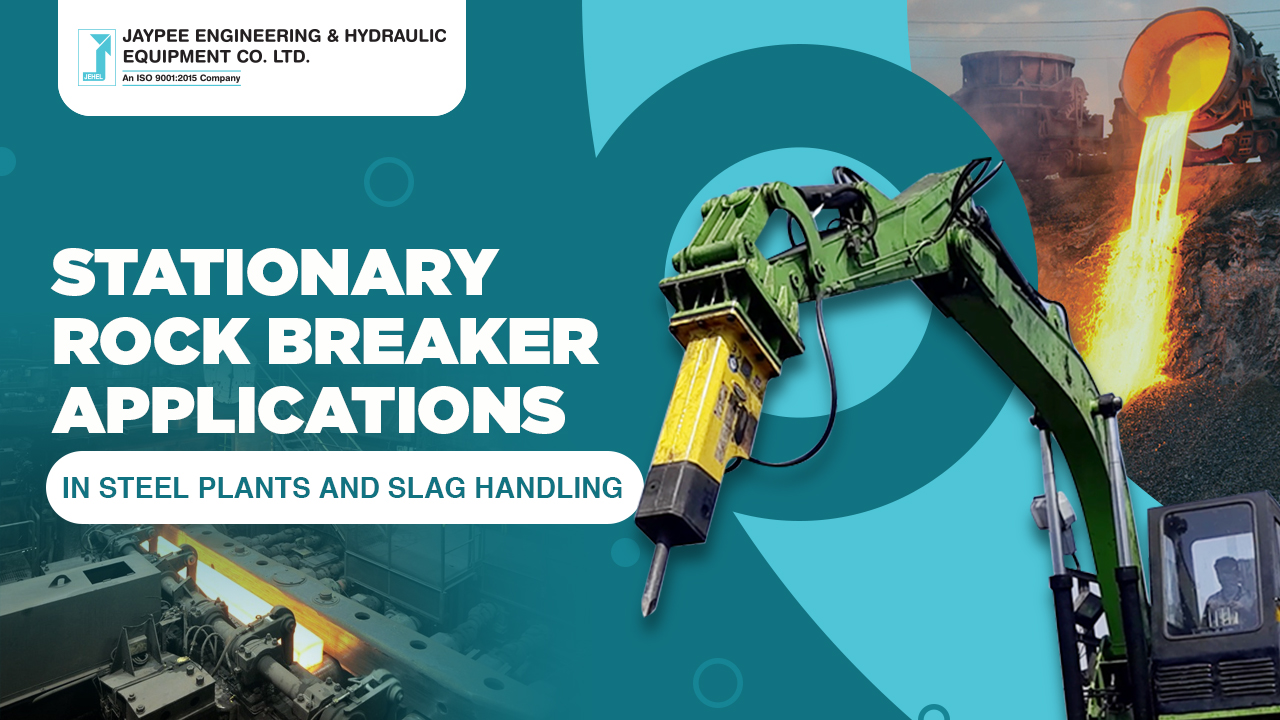
Steel plants never stop. Blast furnaces operate round-the-clock, converters draw the molten metal according to schedules, and the whole process relies on an uninterrupted flow of raw material and by-products management from one end to the other. The by-product in question here is slag. The non-metallic waste produced during the smelting of iron. However, when it solidifies into gigantic and irregular masses, its potential to clog the hoppers, breakers and disrupt the flow of material cannot be underestimated.
Crude steel production in India increased by 10.7% year-on-year and is estimated at 168.4 million tonnes in the financial year 2025-26 [1]. Capacity has been pushed up to about 220 million tonnes, while the target of reaching 300 million tonnes is set for 2030 [2]. Every single steel plant in the country is working hard toward increasing throughput and reducing downtime.
In this blog, we explore how equipment such as the rock breaker for steel plants and slag handling helps resolve one of the key operational issues faced by steel plants today.
The Slag Problem Nobody Talks About Enough
Slag forms due to the separation of impurities from melted metal in the smelting process. After being cooled, slag becomes a tough, irregular-shaped material. Some pieces are easy to handle, while others are not. In particular, ladle skulls can weigh several tonnes and cannot be easily broken using conventional tools.
On a bustling steel production site, it is necessary to cool slag and skulls before loading them into a crusher, trucks, or any other means of transportation through the system of materials handling. Otherwise, slag piles up. Piled-up slag takes up floor space in the slag yard, prevents access to hopper openings, and creates hazardous conditions for the movement of personnel in the slag yard area.
Conventional techniques involve drop balls, excavator hammers, and thermal lancing. The former is inaccurate and dangerous, the latter two are costly and slow, and none can ensure a constant pace of slag treatment.
How Stationary Rock Breakers Fit into Steel Plant Operations
The stationary rock breaker for the steel industry consists of the same basic system design as the stationary rock breaker for mines, but it is designed to suit the needs of steel industrial units. This system is set up on a stationary platform in the vicinity of the slag removal station, raw material hopper, or crushing station.
- Breaks cooled slag chunks and ladle skulls at the crusher hopper
- Pre-sizes raw materials like iron ore and limestone before they enter the crusher
- Handles hot slag in designated cooling bays with heat-resistant configurations
- Clears blockages at conveyor transfer points and bin discharge areas
The hydraulic rock breaker for slag patent is especially useful due to the variability in slag characteristics. A hammer-energy/boom-reach arrangement made by a steel plant rock breaker manufacturer, having familiarity with the material, can adapt its configuration to different slags.
Further reading, explore how stationary rock breakers improve crusher efficiency, reduce downtime, and support safer bulk material handling operations through this rock breaker guide.
Raw Material Handling: The Other Half of the Equation
Slag is not the only substance that comes out of steel plants; they require vast quantities of input material such as iron ore, limestone, dolomite, and coal. These inputs vary in size and have the capability of blocking the hopper when oversized material falls on the grizzly.
The industrial pedestal boom system installed in the raw material crusher hopper performs the same function that it would in a mine, ensuring that the flow is steady without damage to the crusher and the possibility of blockage leading to production issues. In an integrated steel plant with a captive mine, this could very well be the first point of entry for the mine products.
Why India’s Steel Growth Amplifies the Need
For the first time in the financial year 26, India has become a net exporter of finished steel, exporting 6.6 million tonnes, representing an increase of 35.9% compared to the previous year [3]. Companies like SAIL, Tata Steel, and JSW Steel have plans to expand their production capacity [4]. An increase in production capacity leads to an increase in the daily output of raw materials and slag.
If, for example, the capacity of a steel plant increases from 3 MTPA to 5 MTPA, then each handling system receives an additional workload. An increase in the output of the slag storage area, an increase in the crushing of raw materials, and increased downtime costs because of the increase in baseline production.
Stationary rock breaker steel industry depends on the plant. It does not matter whether your plant has a capacity of 3 million or 5 million tonnes per year. The important thing is that it will be installed correctly.
Conclusion
Production of steel is increasing. So are slag productions. The requirement for faster and more dependable breaking of materials during all the stages of handling has never been more important. A rock breaker for steel plants can no longer be considered merely supplementary equipment, but rather as a means for increasing production efficiency and reliability in terms of production uptime.
If it is for breaking the ladle skulls at the slag yards, for crushing the oversized iron ore in the crusher hopper, or even for pre-crushing the limestone in the blast furnaces, investing in an appropriate hydraulic rock breaker pays off in India.
At JEHEL (Jaypee Engg. & Hydraulic Equipment Co. Ltd.), you will find pedestal breakers for steel plant systems designed according to your requirements of boom reach, hammer specs, and mounting types. Their products cater to major steel plants in India, and their 25 engineers give them full after-sales services. To know more about their steel plant solutions, visit jehel.com.