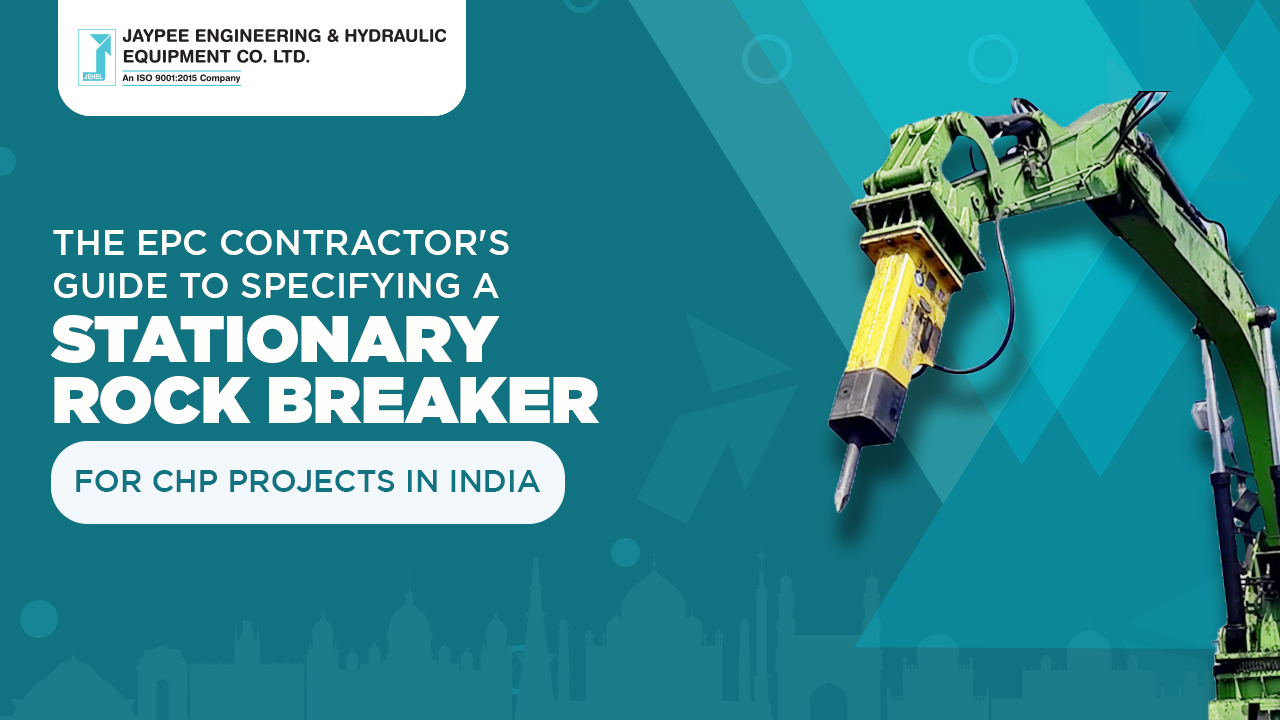
Ask any EPC contractor that has provided coal handling plants in India, and they will confirm that the stationary rock breaker will invariably be the last thing to be procured and often the cause of most commissioning problems. It seems insignificant from a BOQ standpoint. The truth is that it will play a vital role in ensuring how smoothly the CHP operates on the very first day of hot commissioning.
One aspect of the problem is scale. According to India’s Ministry of Coal, India’s coal production rose to a record high of 1,047.52 million tonnes in the FY 2024-25. Going by the current plans and estimates, India will produce close to 1.5 billion tonnes by FY 2029-30.
All thermal power plants and captive CHPs commissioned in India need to cater to a larger volume and shorter unloading time than the previous generation. Any CHP unable to cope with oversized loads during commissioning is an embarrassment to the entire EPC package.
This guide explains what you should consider when specifying a Stationary Rock Breaker in your CHP projects in India.
Start With the Coal Source and Material Profile
The largest single input in specifying your plant is where your CHP’s coal will come from. There are wide variations between Coal India grades in hardness, moisture content, and expected percentage of oversize. Indonesian or South African imported coal will behave entirely differently. When selecting your breaker, consider:
- Coal source and typical grade (G1 to G17, washed or unwashed).
- Expected worst-case boulder size delivered to the grizzly.
- Moisture range across the monsoon and dry seasons.
- Ash content and its effect on hammer wear.
Size the Breaker to the Grizzly, Not the Average
The EPC contractors will specify the rock breaker for CHP by taking into account the average size of the boulder. This practice is wrong. The rock breaker must be sized by its ability to cope with the 95th percentile of the worst case. Slightly oversized rock breaker stays practically unused for two decades. An undersized one will fail in less than one and a half years.
Rule of Thumb: estimate the required impact energy from the perspective of worst-case materials with minimum moisture content and add a safety margin for any eventual change of the coal source.
Mounting and Boom Reach
The pedestal-mounted breaker should be able to cover all four corners of the grizzly rather than just the centre. The boom reach is where most EPC contracts fail. The machine operator cannot move the rock to other locations on the grizzly.
- Confirm grizzly dimensions from the civil-structural drawings, not the BFD.
- Add boom reach margin for unexpected bench drop positions.
- Check headroom above the grizzly for boom swing clearance.
- Verify the pedestal foundation can take impact hammer loads, not just static.
Controls: Cabin vs Radio Remote
For Indian CHPs, the choice for remote control is via radio link. The operator is kept away from any dust or noise and splash hazards. Controls within the cabin will remain useful in situations where there is excessive dust in the environment that may affect the radio signals.
The Spec Sheet Items That Protect Commissioning
The number of things that get overlooked in many EPC specification sheets is surprisingly high. Make sure to include the following non-negotiables when drafting your coal handling plant rock breaker specification sheet:
- Load-test certificate at rated impact energy.
- Named reference sites where the exact model is operating.
- Spares list for the first two years, with local stocking commitment.
- Service response SLA with penalty clauses for delayed response.
- Operator training is included in the commissioning scope.
Why Local Service Capability Decides Long-Term Success
The best-designed breaker in the world fails early if service isn’t local. For an EPC, this matters most after handover, when warranty claims and O&M transitions can drag your team back to the site months after project closure. A breaker backed by an Indian OEM with mobile service engineers saves your warranty period from turning into a support nightmare.
Conclusion
Selecting a rock breaker for a CHP project does not happen on a single page. It is a delicate balance between fuel type, grizzly dimensions, operating cycles, control methods, and post-sale support. The EPC companies that make the proper selection deliver turnkey power plants that start up without a hitch on day one. The companies that take shortcuts will find themselves making frequent trips back to the plant site for years.
If you are selecting a rock breaker for an upcoming CHP project, take the extra week to do your homework on the breaker before placing the purchase order. You should insist on references by name, spare parts inventory, and service level agreement. These three criteria are more effective predictors of reliability than anything listed in brochures or data sheets.
If you are an EPC company that is wrapping up a rock breaker package for a new Indian CHP, please contact the JEHEL team for assistance with developing a specification that stands up through commissioning and beyond.