Steel scrap processing in an EOT crane lift at midnight. The crane moves over a heap of entangled HMS scrap, and the operator makes a fourth attempt at lowering a chain sling since the previous three attempts have failed due to slippage. The furnace is ready for another scrap charge, and the shift supervisor is calculating the number of missed melting cycles. This is a situation that is common throughout India.
The country’s consumption of steel scrap was around 41 million tonnes in the year 2024-25, and as per the National Steel Policy, the target of scrap consumption by 2030 stands at 70 million tonnes annually [1]. Considering the contribution of the secondary steel producers of almost 40% of the crude steel production in the country via electric arc and induction furnaces, scrap logistics becomes critical.
This is exactly where an orange peel grab changes the equation. Tailor-made to manage difficult, bulk and tangled items, it is able to do everything that chains, buckets, and manual sorting just cannot keep up with. It’s time we explored what exactly it does and where its impact will be felt most.
What Makes an Orange Peel Grab Different
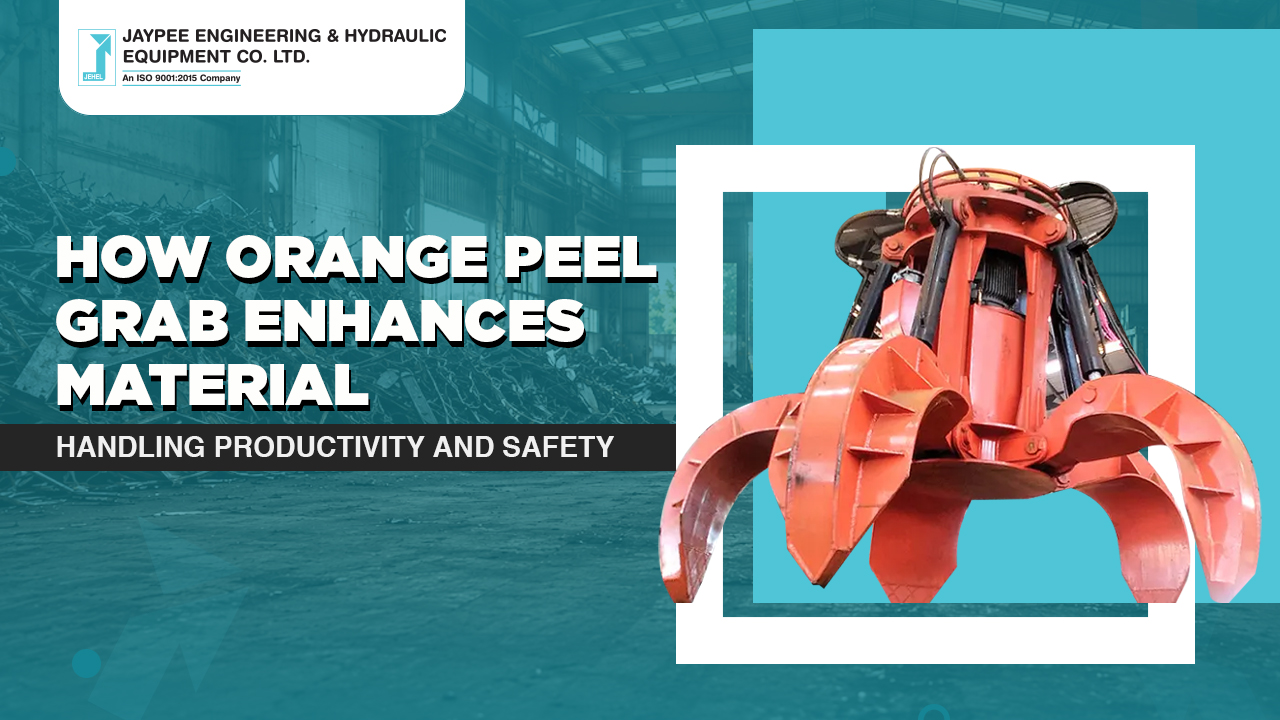
The name is attributed to the design itself. The orange peel grab consists of more than one tine, usually four or five, and operates in a way where the tines spread and retract like the segments of an orange peel. It is able to hold any irregularly shaped load, wrapping around from different angles, by gripping rebar, scrap metal from automobiles, dismantled structural steel, and loose industrial trash.
This is unlike the clamshell bucket, which can only be used to move loose and uniform materials, and the chain slings, which need rigging and often fail to grip the irregular material. The orange peel grab is capable of holding, lifting, and placing the material using just one automated process and with no one around the load.
Productivity Gains That Actually Show Up on the Shop Floor
In high-scrapping operations, it’s the loading cycle that wastes time. Every attempt to rig a load manually, every readjustment of a sling and every drop of a load costs time and multiplies throughout the shift. Using an electro-hydraulic orange peel grab installed on an EOT crane, stationary crane, or mobile crane reduces the loading cycle significantly since the grab performs the gripper function, which should be done manually otherwise.
A normal alloy steel mill or induction furnace unit switching from chain lifting to an orange peel grab system will gain about 15% to 25% furnace charge cycles per shift. This is not only the percentage but the difference between timely charging of a furnace and waiting until the next load is rigged.
Moreover, there is a density issue. Tines of the grab press and compact scrap while grabbing, thus creating a denser load than loose sling loads. Fewer crane cycles per furnace charge equals higher output rate with the existing crane equipment.
Safety Is the Other Half of the Equation
The Indian steel and scrap industries have always been dependent upon human effort for processes such as sorting, rigging and positioning of loads. This exposes workers to loads lifted by cranes, scrap materials with sharp edges and falling loads that are heavy.
The orange peel grab, which operates either remotely or within the cabin of a crane, lifts the load without putting humans in harm’s way. The grab is operated remotely and, with the help of hydraulic power, it ensures that the load does not sway, slide or scatter.
The inclusion of pressure relief valves and lock mechanisms also provides additional safety in case of any hydraulic problem while lifting loads. Such a device works well for plants operating on a three-shift system.
Where It Fits: Industries and Applications
The orange peel grab isn’t limited to steel plants. Its design makes it effective across a range of heavy material handling environments:
Scrap yards and recycling centres: Working with HMS, shredded steel, auto scrap, and demolition waste of non-uniform shapes.
Alloy and stainless steel mills: Charging furnaces with scrap of irregular shapes that are locked together. More charging leads to more melting cycles a day.
Ports, logistics terminals, and waste management: Loading/unloading bulk scrap onto/from ships, rail cars, and trucks, plus MSW and C&D waste processing.
Getting the Specification Right
Selecting the correct orange peel grab is based on some practical variables. The grab capacity must be compatible with the safe working load and normal lifting volume of your crane. JEHEL provides grabs ranging between 0.3 and 1.5 cubic meters, suitable for use with induction furnaces and scrap yards.
The number of tines is another factor to be considered when purchasing an orange peel grab. Tines of lesser weight and density will require larger numbers, while the dense and heavy metals will be lifted using smaller numbers of tines for increased holding force.
The kind of mount also needs to be taken into consideration.
Conclusion
There are certain aspects of operations which seem trivial until they become big enough to have an effect. A loss of 10 minutes per charge per furnace, accumulated over 3 shifts and 300 operational days per year, can easily result in a significant production loss in terms of hours. The orange peel grab eliminates the variations leading to those losses.
With the scrap consumption in India set to almost double by 2030, there will be additional pressure on the handling systems. Facilities adopting a mechanical solution to scrap handling today would be better prepared for dealing with the increased load without increasing labour, risk, or downtime costs proportionally.
JEHEL produces electro-hydraulic orange peel grabs with different capacities and mountings for steel plants, scrap yards, port facilities, and waste handling facilities. Having an in-house design department and service network covering India and other countries, JEHEL can offer optimal orange peel grab solutions depending on your crane specifications and needs.