If you walk into any cement, steel, or mining facility during peak intake hours, you’ll witness this exact problem in action. A line of trucks is backed up, all waiting their “turn” to back into an unloading area. One truck takes too long to get back into position, another truck is in the wrong position, and suddenly, the whole unloading area is backed up. Time is being wasted, and it’s adding up faster than most operations managers are willing to admit.
The cost of inefficient truck unloading goes beyond wasted fuel and driver time. It also translates to reduced throughput in crushers, hoppers, and all downstream equipment. When raw material intake is slowed, productivity goals are in jeopardy before the first half of the shift is even complete.
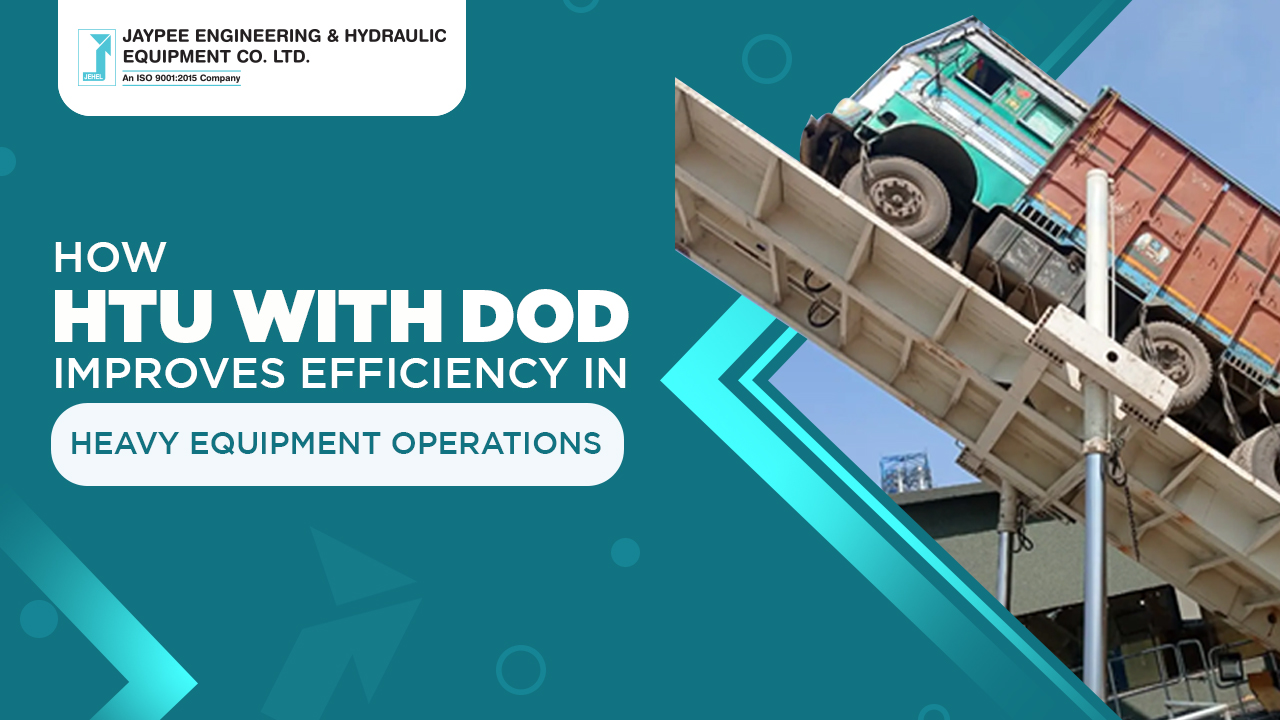
This is exactly what Hydraulic Truck Unloader systems with Drive-over Design are engineered to fix. With a completely redesigned process, HTU with DoD removes all of those previously problematic steps without requiring anything of the driver or operations staff.
The Numbers Tell Part of the Story
Before getting into how the technology works, it helps to look at what industry data says about bulk material handling at large. The global bulk material handling equipment market is valued at USD 51.19 billion in 2025 and is expected to reach approximately USD 78.15 billion by 2033, growing at a CAGR of 5.47%. (Source: Straits Research, 2025)
This growth is being driven by an urgent need among plant operators to expand material handling capacity without committing to major infrastructure investment. New-generation bulk material handling solutions can reduce operational expenses up to 25 per cent as they can increase efficiency and reduce equipment downtime. (Source: Future Market Insights, 2025)
Those are the kinds of numbers that make plant managers pay attention. And the unloading bay, overlooked as it often is, is frequently where the most immediate efficiency gains are sitting.
What the Drive-Over Design Actually Changes
With a standard hydraulic truck unloader, the driver must reverse the truck into the unloader, a process that is slow in a typical plant environment and requires spotters to guide positioning. Any misalignment means the truck has to pull out and attempt the reversal again, adding time and frustration to every cycle.
This is eliminated with the Drive-Over Design. The truck drives up onto the tilting platform, is secured, and then the hydraulic system raises it to the discharge angle. Once unloading is complete, it departs from the opposite end in the same direction as it arrived. There is no need to back up, reposition, or wait for the driver to approach again.
What This Means for Cycle Time
The efficiency gain comes from eliminating a step, reversing the truck, that was always built into the cycle but never added any productive value. Reversing a loaded truck, especially a long trailer, onto a fixed platform is a slow process by design. In operations running fifty to a hundred trucks per shift, cutting two to four minutes per cycle directly translates to more trucks processed without any increase in equipment or manpower.
This is not a theoretical process. It is changing the number of cycles completed per shift, and that equates to more processed material for the receiving end of the process.
Hydraulic System Demands and Load Capacity
The HTU platform itself is also capable of handling considerable loads. The capacity of this platform is usually between 40 and 100 tonnes, depending on the truck types. The hydraulic cylinders are also able to tilt the loaded platform up to 55 degrees.
However, it is important to ensure that the hydraulic power pack driving this system is properly sized according to the tipping angle, weight of the platform, and cycle frequency. Plants handling large numbers of trucks on a daily basis require systems designed for cycle life, not just rated capacity on paper.
Safety and Plant Layout Considerations
One often overlooked benefit of Drive-Over Design is its impact on accident reduction, something that does not show up directly in cycle time calculations but matters significantly on the ground. Eliminating reversals in a congested unloading area directly reduces the number of blind-spot manoeuvres, which are the primary source of incidents involving spotters, ground crew, and nearby equipment.
From a plant layout point of view, a drive-through unloading design can also provide a better traffic pattern since it separates incoming and outgoing trucks instead of forcing them to converge in a common area of reversal.
Conclusion
Efficient raw material intake is the foundation on which all downstream processes depend. When the unloading bay is running smoothly, feed rates are consistent, lines are kept loaded, and goals are achievable. When it is not, it is felt throughout the entire process.
For plants that handle large volumes of trucks, a strong investment in this stage of intake is not a luxury; it is a necessity. It is where the productivity of the entire intake process is either enhanced or hindered, and it is where the numbers being generated at the end of the day are determined.
JEHEL specialises in the design and construction of Hydraulic Truck Unloaders, including Drive Over Design configurations, to meet the needs of heavy industrial intake processes. For plants that need a reliable, efficient unloading solution engineered around their specific trucks and facility layout, JEHEL has the expertise and resources to deliver it.