You walk into an exhibition hall. There are 200 booths. Forty of them sell some version of hydraulic equipment. Every banner says quality. Every brochure says trusted. Every salesperson says best in class. By lunch, they all blur together. By the time you leave, you’ve got a bag full of catalogues and no clear idea of who’s actually worth a phone call next week.
We’ve been on both sides of this. As a hydraulic equipment manufacturer in India exhibiting at trade fairs for over two decades, we’ve watched procurement teams walk past booths that would have served them well and stop at booths that looked impressive but had nothing behind the banner. The difference between a good exhibition visit and a wasted one comes down to knowing what to check.
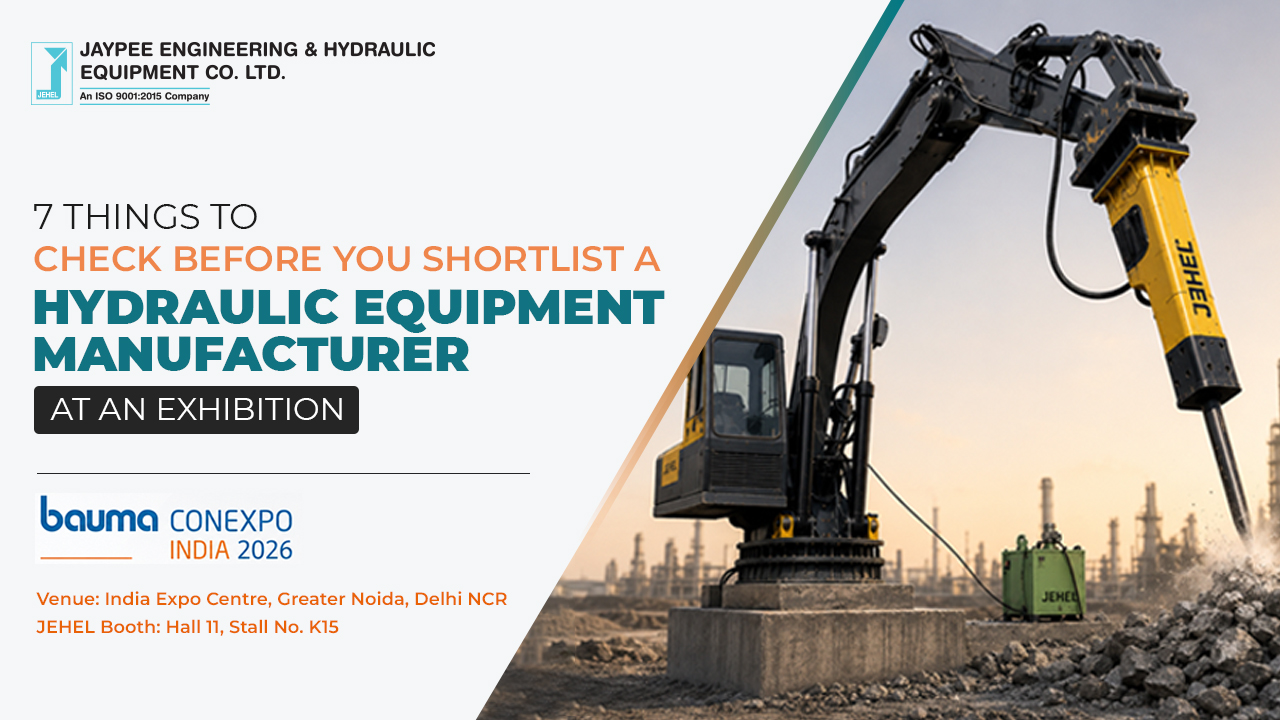
Here are seven things experienced buyers look for when evaluating a hydraulic equipment manufacturer at a trade fair. Use them at bauma CONEXPO INDIA 2026 (15 to 18 September, India Expo Centre, Greater Noida) or at any industrial exhibition you attend.
1. Check Whether They Brought Actual Equipment
This is the first filter. Some booths display machines. Others display screens showing videos of machines. The difference matters. If a manufacturer has shipped a truck tippler platform, a rock breaker boom, or a hydraulic grab to the exhibition floor, that’s a statement about confidence in their product. If all they’ve brought is a TV and a stack of brochures, ask yourself why.
Touch the equipment. Run your hand along the welds. Check the cylinder rod finish. Open the power pack cover. These details are invisible in a catalogue.
2. Ask Who Manufactures What
This is the question that separates actual manufacturers from assemblers and traders. Do you make the boom arm in-house? Where are the hydraulic cylinders manufactured? Who supplies your pump and valve assemblies?
A manufacturer who controls their own fabrication, machining, and assembly can customise. A trader who sources from three different factories cannot. At an exhibition, you’ll get an honest answer faster than you would over email, because the equipment is right there and the engineer can point to the component and tell you where it came from.
3. Look at the Hydraulic Power Pack
The power pack is the heart of every hydraulic machine. It’s also the component that most buyers overlook during an exhibition visit because it’s not as visually impressive as the boom or the platform. That’s a mistake.
Open the cover. Check the pump brand. Rexroth and Parker are the benchmarks. Look at the valve block. Is it a custom manifold or a generic plate? Check the filter housing. Check the oil cooler. A well-built power pack tells you more about a manufacturer’s quality standard than any ISO certificate on the wall.
4. Ask for Reference Sites You Can Visit
Any manufacturer can claim 10,000 installations. Ask for five sites you can actually visit. Specifically, ask for sites in your industry (cement, steel, mining, power) that have been running the same model for at least two years.
The willingness to provide reference sites, and the speed with which they do it, tells you a lot. A confident manufacturer will give you names, locations, and contact persons on the spot. A hesitant one will promise to send the list later. Later usually means never.
5. Test the After-Sales Story
Ask three questions:
- How many service engineers do you have in the field?
- What’s your average response time for a breakdown call?
- Where do you stock spare parts?
The answers separate manufacturers who build long-term relationships from those who disappear after dispatch. If the service team is five people covering all of India, your breakdown response in a remote mining location is going to be measured in days, not hours.
6. Bring Your Site Specifications and Watch Their Response
This is the most underused evaluation technique at exhibitions. Bring a one-page summary of your plant requirements: hopper dimensions, truck fleet details, crane capacity, material type, throughput target. Hand it to the engineer at the booth.
A real manufacturer will start sketching a configuration on the spot. They’ll ask follow-up questions about your site layout. They’ll pull out reference drawings from similar installations. A trader will take the sheet, thank you, and promise to get back to you. The booth conversation tells you whether you’re talking to a manufacturer or a middleman.
7. Compare the Same Product Across Three Booths
If you’re evaluating truck tipplers, visit at least three manufacturers who make them. If you’re looking at rock breakers, do the same. Stand at each booth for 15 minutes. Ask the same questions. Then compare the answers.
You’ll quickly see who knows their product and who’s reading from a script. You’ll spot the differences in build quality that no brochure comparison can reveal. And you’ll develop a shortlist based on firsthand experience rather than Google rankings.
The Exhibition Is the Evaluation
Procurement teams often treat exhibitions as information-gathering trips and leave the real evaluation for later: factory visits, reference calls, technical comparisons done from the office. That approach works, but it’s slow. An exhibition gives you the chance to do 80% of your evaluation in four days if you walk in with the right checklist.
The seven checks above aren’t theoretical. They’re what experienced plant engineers and procurement heads do instinctively after years of buying equipment. If you’re earlier in your career or new to equipment procurement, this list gives you the same evaluation framework in a single page.
JEHEL (Jaypee Engineering & Hydraulic Equipment Co. Ltd.) will be at Hall 11, Stall K15 during bauma CONEXPO INDIA 2026 (15 to 18 September, India Expo Centre, Greater Noida). We welcome all seven checks. Bring your specifications, open our power packs, ask for reference sites, and compare us against anyone else on the floor. That’s how good decisions get made. Contact us at jehel.com/contact or +91 9051617609.
SOURCES
- bauma CONEXPO INDIA 2024 data (984 exhibitors, 51,118 visitors): bcindia.com/en/trade-fair/data/numbers/