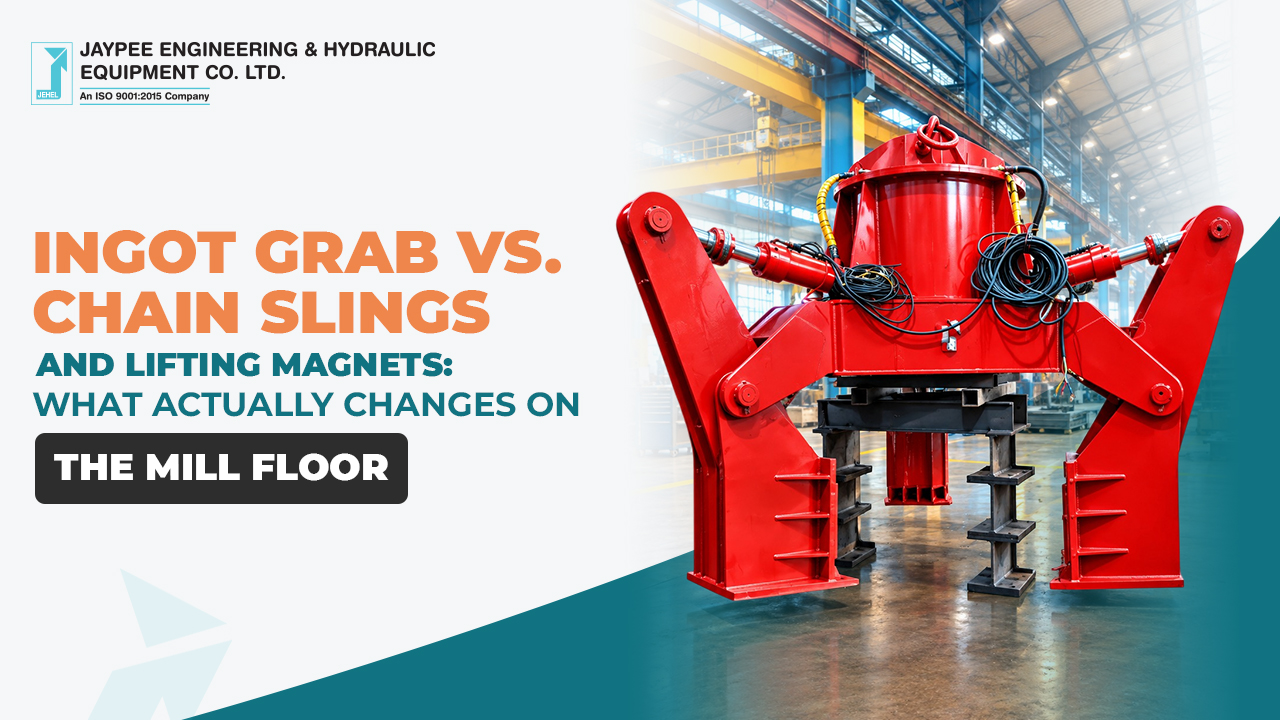
Walk onto the hot ingot bay of a mid-sized Indian steel mill, and you’ll see three generations of technology sharing the same floor. Chain slings looped around cooling blooms. A lifting magnet swinging between the soaking pit and the rolling mill. And, in some bays, a hydraulic grab that handles ingots one after another without a crew climbing anywhere near the load.
The debate about which handling method is actually best isn’t new. What’s changed in the last few years is the economics. Labour costs have risen, insurance premiums tied to lifting incidents have climbed, and mill availability targets are tighter than they used to be. Managers who tolerated chain-sling shift times a decade ago are now looking at every minute of handling as recoverable production time.
This post looks at what actually changes when a hydraulic Ingot Grab takes over from chain slings or lifting magnets on the mill floor. Not the glossy brochure version. The gritty, shift-level version that decides whether the investment pays back.
What Chain Slings Do Well, and Where They Fail
Chain slings are cheap, flexible, and familiar. A hooker can rig almost anything with a few chains and some practiced knotwork. For odd-shaped loads or occasional lifts, nothing beats them for versatility.
Where they fail is in repetition. Every chain-sling lift needs manual rigging. Every lift exposes a worker to the load. Every rigging cycle adds minutes to the handling time. On a hot ingot that cools fast, those minutes compound into real temperature loss, more reheat energy, and a thinner production margin.
The Lifting Magnet Problem Nobody Wants to Admit
Electromagnets look like the answer to the chain-sling slowness problem. Energise, lift, move, de-energise. Clean and quick. But magnets have limitations that steel mills have learned the hard way:
- Hot ingots above the Curie point lose magnetic susceptibility, grip weakens.
- Scale, slag coating, or oxide layers reduce holding force unpredictably.
- Power failures mean dropped loads, with safety and equipment damage risks.
- Magnetic residue on ingots can carry over to downstream machining issues.
- Non-ferrous handling is simply impossible, making the magnet single-purpose.
What a Hydraulic Ingot Grab Actually Changes
A hydraulic ingot grab solves the recurring handling problem in a different way. It grips mechanically. It doesn’t care whether the ingot is above or below the Curie point. It doesn’t lose grip in a power failure because the hydraulic circuit holds pressure. And it can be cycled thousands of times per month without a crew member ever touching the load.
The mill-floor changes show up in a few specific places:
- Cycle time per ingot drops from manual rigging windows to seconds.
- Handling crews move from rigging duty to supervision and QA duty.
- Insurance claims from sling-related finger and crush injuries fall sharply.
- Hot ingot temperature loss during handling reduces, lowering reheat energy.
- Loads travel more predictably, which means fewer collisions with structures.
The Math Steel Managers Are Running
Indian steel production reached about 158 million tonnes of finished steel in FY 2024-25 per the Ministry of Steel, and capacity is still expanding. Every mill is under pressure to squeeze more throughput from existing bays. The grab-versus-sling question has moved from an operational preference to a direct capacity question.
A typical payback calculation for an ingot grab retrofit comes in under 18 months at most mid-sized mills. The headline savings come from cycle time and labour redeployment. The unglamorous savings, which actually add up to more, come from reduced reheat costs, fewer incidents, and lower scrap rates from mishandled loads.
Where Chain Slings and Magnets Still Make Sense
None of this means chain slings and magnets are obsolete. For oddly shaped one-off lifts, a chain sling remains the most flexible tool on the mill floor. For cold scrap-yard handling of ferrous loads, a magnet is still the fastest option. The point isn’t to replace them everywhere. It’s to recognise where a grab is genuinely a better fit and stop forcing old methods into repetitive high-cycle work they were never designed for.
Conclusion
The mill floor isn’t static. The handling methods that defined the 1990s weren’t built for the throughput, safety standards, or energy economics of today’s integrated plants. Where repetitive hot or cold ingot handling is on the critical path, the grab usually wins on both operational and financial grounds.
The best time to evaluate this isn’t during a crisis. It’s during a planned shutdown or capacity expansion, when the civil, electrical, and crane modifications can be sequenced without disrupting production. Mills that wait for a sling incident or a magnet-drop event to force the decision end up paying more for less.
If you’re weighing an ingot grab retrofit for your mill, JEHEL designs hydraulic ingot grabs for EOT and stationary crane mounting across Indian steel plants, with in-house manufacturing and a 25-engineer service team covering India and abroad. Reach out to the JEHEL team with your ingot dimensions, crane capacity, and cycle targets for a grab configuration that actually fits your bay.
Frequently Asked Questions
Q1. How is an ingot grab different from chain slings and lifting magnets?
An ingot grab grips the load mechanically with hydraulic jaws. Chain slings need manual rigging every lift. Magnets rely on electromagnetic force and only work on ferrous loads. The grab wins on repetitive, high-cycle handling.
Q2. Can an ingot grab handle hot ingots above 300°C?
Yes, if it is built for high temperature. That means alloy jaws, fluorocarbon seals, synthetic hydraulic oil, and heat shielding. A standard cold-handling grab will fail quickly in a hot bay.
Q3. Why do lifting magnets lose grip on hot ingots?
Ferrous materials lose magnetic properties as they approach the Curie point. Scale and oxide layers reduce grip further. For hot ingot work, a mechanical grab is safer and more reliable.
Q4. How quickly does an ingot grab pay back?
At most mid-sized Indian steel mills, payback is typically within 18 months. Savings come from faster cycles, lower rigging labour, fewer sling injuries, and reduced reheat energy from less temperature loss during handling.
Q5. Do I still need chain slings or magnets after installing an ingot grab?
Yes, for the right jobs. Chain slings stay useful for odd-shaped one-off lifts. Magnets suit cold-scrap handling. The grab replaces them specifically on high-cycle repetitive work.