At 3 o’clock, there is yet another instance of the primary breaker stalling, not for the first or second, but for the third time during the shift. As usual, there is always one cause: a boulder blocks the grizzly, the feed runs dry, and soon a string of haul trucks is idling on the haul road. No one is waiting for reasons anymore. All they want to know is how much money is required to get things done.
This scenario keeps repeating itself at all OCPs of India, more often than the heads of the plants care to acknowledge. At the peak of its coal production period, India recorded the highest-ever figure of 1,047.52 million tonnes of coal output during FY 2024-25, according to the Ministry of Coal. By FY 2029-30, the targeted output is expected to be 1.5 billion tonnes.
Such production figures put immense pressure on every OCP’s feed circuit. Every oversized boulder blocking a primary breaker at large OCPs directly impacts national coal production figures.
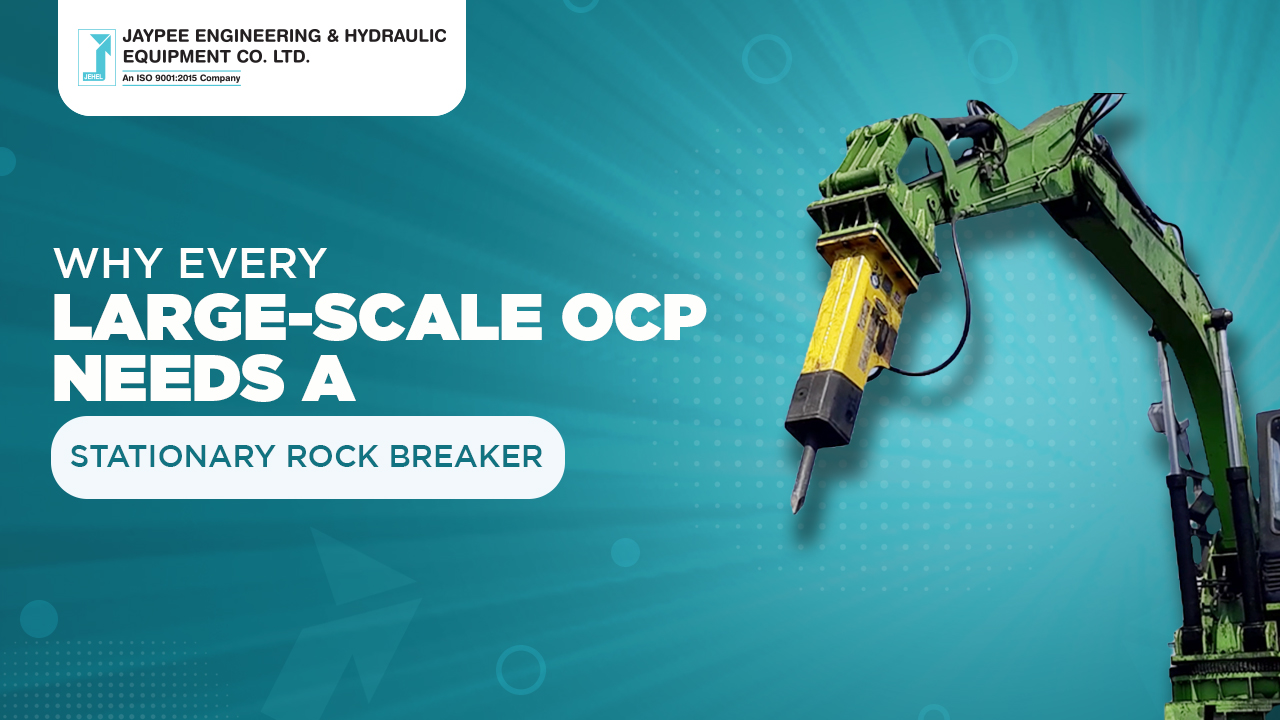
India’s major mining sites have already found the solution. For OCP operations of significant scale, a strategically placed and appropriately sized Stationary Rock Breaker is not an optional extra but a necessity. This is the lesson learned from some of the most successful operations.
Why OCPs Suffer More Than Other Mines
There is nothing like scalability in open-cast coal mining in India. The heights of the benches are high, the blasting pattern results in a diverse size distribution, and haul trucks have a capacity exceeding 100 tons regularly. This is all processed in a primary crusher designed for a certain top size.
Any deviation from the blasting pattern or the entry of even a single boulder in the circuit through the grizzly stops the entire operation chain. In small-scale mining, one can always manage, but in a large-scale mine, this is a disaster.
What India’s Biggest Coal Mines Do Differently
Enter any coal mining unit’s control room in the form of OCP, belonging to Coal India Limited, as well as any other mines under the jurisdiction of SCCL and NLC, and one would invariably spot one commonality. The grizzly is equipped with a rock breaker for OCP, installed right above it. Neither do miners need to manually break down oversized lumps, nor do cranes get deployed for lifting a boulder at a time.
The lessons from these high-volume sites come down to a few practical principles:
- Size the breaker to the 95th percentile boulder, not the average one.
- Mount it on a pedestal that covers the full grizzly area with boom reach to spare.
- Use radio remote or cabin control so operators stay safe and stay productive.
- Spec the hydraulic power pack generously; undersized packs are the first failure point.
The Real Cost of Not Having One
The management fails to recognise the true expense associated with oversized processing at an OCP. This includes not only the downtime caused by the stoppage of the jaw crusher but also the accumulation of haul trucks waiting for their turn, idling shovels, safety hazards from having workers manually removing oversize on a live grizzly, and faster wear of crusher liners not designed to withstand such impacts.
Multiplying all this by 300 hours per annum makes this issue quite problematic. A rock breaker designed correctly can pay off its own price in just one quarter, not one year, of downtime avoidance.
Why Imported Premium Isn’t Always the Answer
OCPs have invested in top-quality imported rock breakers and still faced problems not because of the quality of the machine, but due to the unavailability of the open-cast coal mine rock breaker local service chain. Faulty tool steel, defective seal kits, or worn bushings might be left idle for weeks while waiting for parts to be delivered overseas. In the meantime, the operation suffers from downtime losses.
However, the operations that have managed to achieve high uptime levels have found the right balance between imported machines of good quality and local service support.
What to Spec Before You Buy
Before contacting any suppliers about a breaker for either a new OCP or an old one at a current mine, follow this list. Check the size of the grizzly, average and maximum sizes of the boulders, amount of tons per day, compressive strength of the rock, reach of the boom, access to power, and service response time.
The last one is what procurement departments tend to overlook, but is actually the most crucial factor in ten years of operation.
Conclusion
The trend from the largest coal mines in India is quite clear. When it comes to the OCP scale, a stationary rock breaker is not just a bonus item anymore. This upgrade is key to ensuring the reliability of your crushing process and haulage cycle.
Leading mines in terms of productivity no longer discuss whether to add this crucial equipment. Instead, they focus on choosing the optimal design, hydraulic system, and maintenance partnership. These are all factors that will ensure maximum availability throughout your equipment’s lifecycle. This is precisely what makes smaller OCP facilities learn faster.
For those looking to plan, upgrade, or retrofit a stationary rock breaker to their OCP, we at JEHEL have been engineering stationary rock breaker solutions for Indian mines dealing with coal, iron ore, and cement since 1995. Contact our experts now and provide details on your grizzly setup, common boulder size, and tonnage per day for a tailor-made solution.