A stockyard manager at a thermal power plant needs to move 300 tons of coal per shift from the pile to the conveyor. A scrap yard supervisor at a steel mill needs to load irregular chunks of metal into trucks. Both need a grab. Both are wrong if they pick the same one.
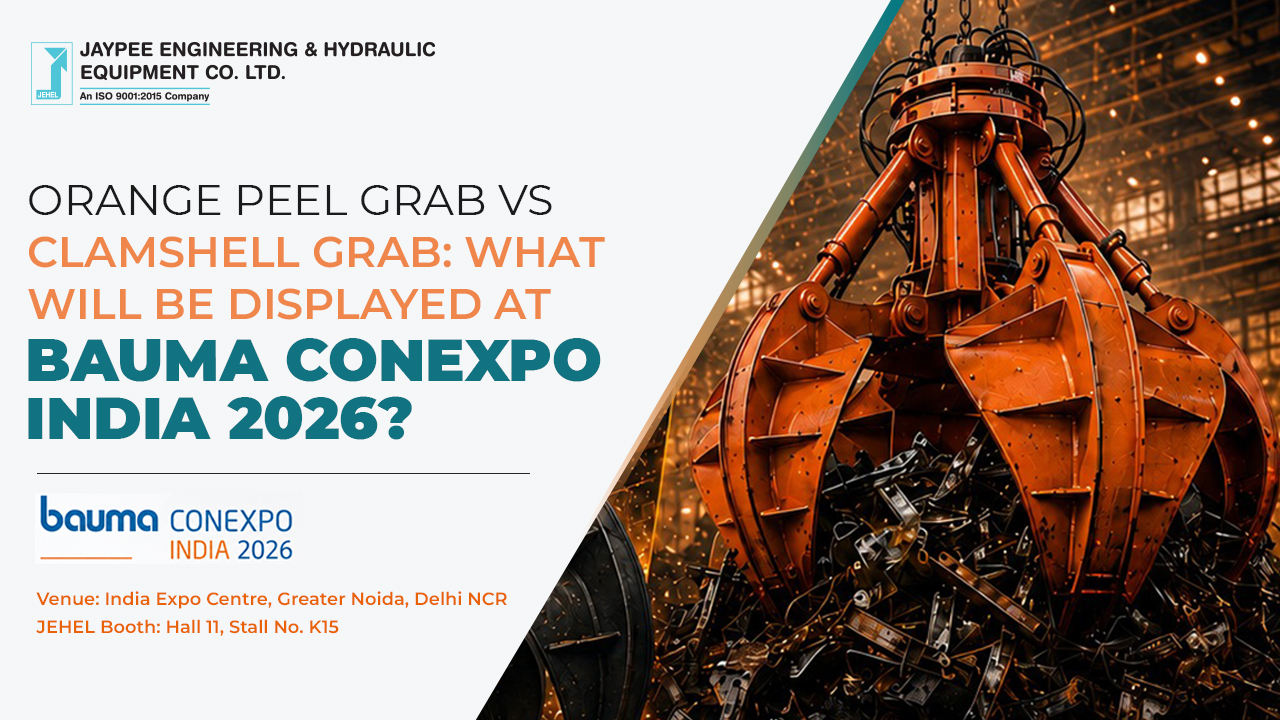
The Orange Peel Grab at bauma CONEXPO 2026 and the Clamshell Grab at bauma CONEXPO 2026 will both be on display at JEHEL’s booth, Hall 11, Stall K15, India Expo Centre, Greater Noida, from 15 to 18 September 2026. Seeing them side by side is the fastest way to understand why one works for your material, and the other doesn’t.
But before you get to the exhibition floor, here’s a clear breakdown of what each grab does, where it works best, and how to decide between them.
The Clamshell Grab: Built for Bulk
Think of it as two giant scooping shells hinged at the top. They open wide, drop into a material pile, and close together to capture a load. The shells seal against each other, which means minimal spillage during the lift.
This design works because bulk materials like coal, iron ore, limestone, gypsum, and fly ash have consistent particle sizes. They settle into the shell cavity evenly. The closing force compresses the load. The sealed edges hold it in place.
Where clamshell grabs perform best:
- Coal stockyards at thermal power plants.
- Iron ore and limestone handling at steel mills.
- Gypsum and fly ash handling at cement plants.
- Wagon unloading at rail sidings.
- Ship hold discharge at ports.
- Wood log handling at paper and plywood mills.
JEHEL’s clamshell grabs use electro-hydraulic operation with a self-contained power unit on the grab frame. No external hydraulic lines from the crane. The grab weight and bucket volume are configured to match the crane’s safe working load.
The Orange Peel Grab: Built for Irregular Loads
Now imagine trying to scoop a pile of twisted rebar, broken concrete, and mixed demolition waste with two flat shells. It doesn’t work. The material is too irregular. Pieces stick out. The shells can’t close.
That’s why orange peel grabs exist. Instead of two shells, they use multiple times (typically four to six) that close inward like the segments of a peeled orange. The times wrap around irregular shapes, grip them from multiple angles, and hold them during the lift.
Where orange peel grabs perform best:
- Scrap metal yards at steel mills and recyclers.
- Demolition debris handling at construction sites.
- Municipal solid waste at transfer stations.
- Mixed industrial waste at processing facilities.
- Ship-breaking yards.
JEHEL’s orange peel grabs use the same electro-hydraulic system as the clamshell range. Self-contained power unit. No external lines. Available for EOT, gantry, stationary, and mobile crane mounting.
Side by Side: How They Compare
- Material type: Clamshell for granular bulk. Orange peel for irregular and mixed loads.
- Closure: Clamshell seals tight for minimal spillage. Orange peel wraps around odd shapes.
- Fill consistency: Clamshell gives repeatable bucket fills. Orange peel varies with load shape.
- Crane compatibility: Both mount on EOT, gantry, stationary, and mobile cranes.
- Power system: Both use self-contained electro-hydraulic units on the grab frame.
- Maintenance: Similar. Both need hydraulic oil changes, seal inspections, and pivot pin checks.
The Mistake Most Buyers Make
Here’s what we see regularly. A plant buys a clamshell grab because it’s the default choice, then tries to use it for scrap or demolition debris. The shells can’t close around irregular pieces. Material falls out during the lift. Cycle times increase. The operator compensates by taking smaller bites. Productivity drops.
The reverse also happens. A scrap yard buys an orange peel grab, then tries to handle fine coal or fly ash with it. The times don’t seal. Material pours through the gaps. The bucket fill is half of what a clamshell would deliver.
The solution isn’t complicated. Match the grab to the material. If you handle both types at your facility, you may need both grabs on the same crane, swapping them based on the job. That’s a common setup at steel mills and multi-material stockyards.
What to Inspect at the Exhibition
When you visit Hall 11, Stall K15, here’s what to check on both grab types:
- Shell or tine edge geometry. This determines how well it seals or grips.
- Pivot pin hardness. High-cycle operations wear pins fast.
- Hydraulic cylinder quality. Look for branded components.
- Power unit layout. Clean hose routing means better maintenance access.
- Grab weight vs your crane capacity. Bring your crane spec sheet.
Exhibition Details
- Event: bauma CONEXPO INDIA 2026
- Dates: 15 to 18 September 2026
- Venue: India Expo Centre, Greater Noida, Delhi NCR
- JEHEL Booth: Hall 11, Stall No. K15
- Timings: 10:00 AM to 6:00 PM (Sep 15-17), 10:00 AM to 5:00 PM (Sep 18)
Two Grabs, Two Jobs, One Decision
The choice between an orange peel grab and a clamshell grab isn’t about which one is better. It’s about which one matches your material. Get that match right, and the grab runs efficiently for years. Get it wrong, and you’ll fight spillage, slow cycles, and premature wear from day one.
Seeing both grabs at the same booth, built by the same manufacturer, with the same electro-hydraulic system, is the most direct way to compare them. You can hold the shell edge of the clamshell and the time of the orange peel in the same visit and understand exactly why they’re shaped differently.
JEHEL will have both grab families at Hall 11, Stall K15 during bauma CONEXPO INDIA 2026. To discuss your material type, crane specifications, and grab sizing before the event, reach out at +91 9051617609 or through jehel.com/contact.
SOURCES
- bauma CONEXPO INDIA 2024 post-show data (51,118 visitors, 984 exhibitors): bcindia.com/en/trade-fair/data/numbers/