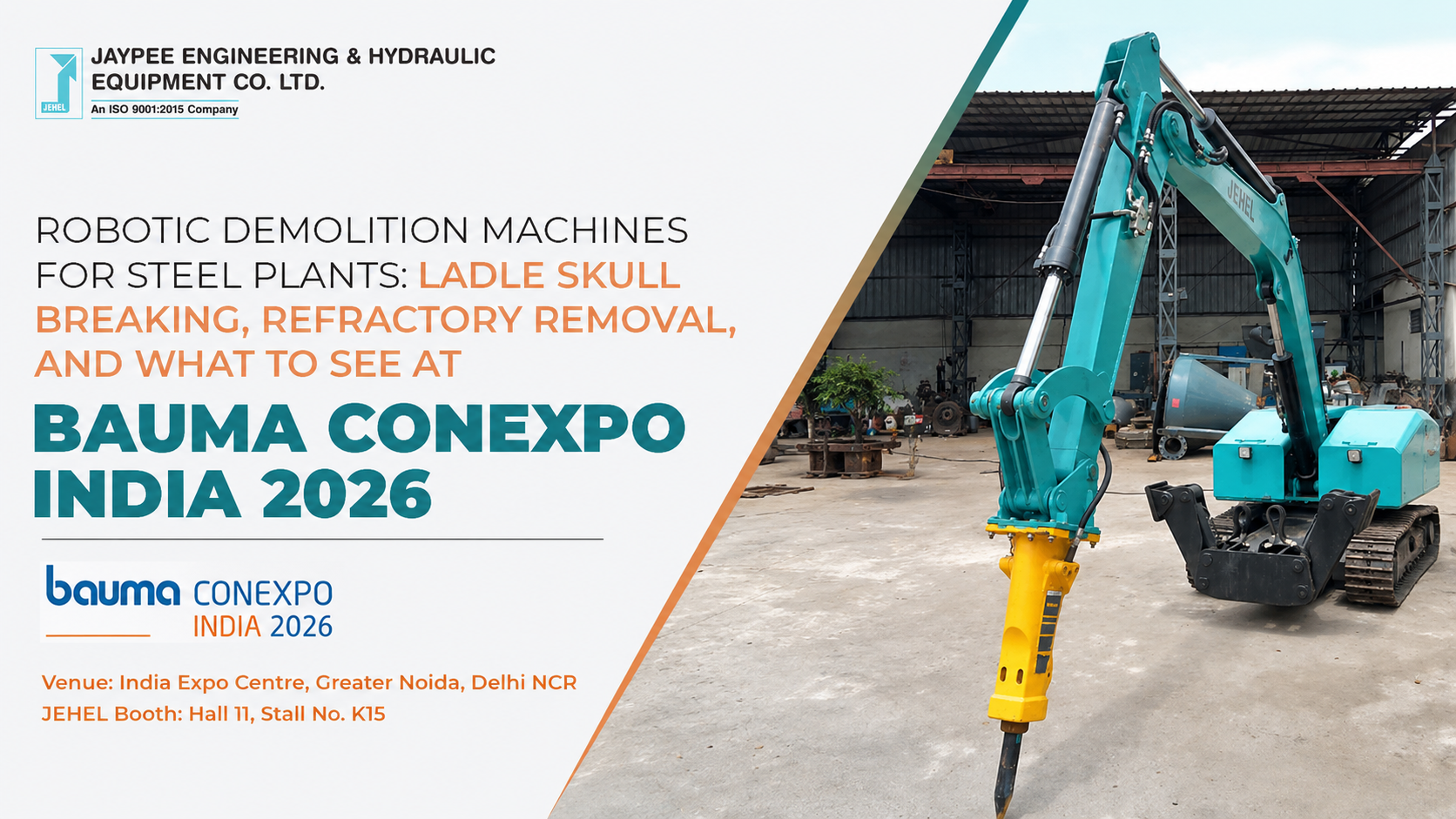
Metal processing plants deal with some of the toughest maintenance and material-removal jobs in industry. Hardened slag, refractory, accretions, skulls, scale, build-up and other difficult materials often need to be broken, removed or cleared from confined areas.
Traditionally, these jobs have relied on manual labour, pneumatic breakers, cranes or conventional excavators. Each method has limitations—particularly when the work area is confined, hot, difficult to access, or requires workers to operate close to the material being demolished.
A robotic demolition machine offers another approach.
The JEHEL BOXER series is a compact, electric-powered, remote-controlled demolition machine designed to carry out breaking, demolition and material-handling operations while allowing the operator to remain outside the immediate work zone.
Although ladle skull breaking and refractory removal are important applications, the machine’s capabilities extend far beyond steel ladle cleaning. It can be used across steel plants, ferroalloy plants, foundries, non-ferrous metal processing facilities, mining and mineral-processing operations, and other heavy industrial environments.
The BOXER can also perform many tasks normally assigned to a conventional excavator or demolition machine—without requiring the space, fuel consumption and operating cost associated with bringing a large excavator into a confined industrial area.
What Is a Robotic Demolition Machine?
A robotic demolition machine is essentially a compact, remotely operated hydraulic machine equipped with a demolition attachment such as a hydraulic breaker.
Instead of placing an operator inside a hazardous or confined work area, the machine is positioned at the work location while the operator controls its movements remotely.
Depending on the application and attachment, the machine can be used for:
- Breaking hardened slag and skull.
- Removing refractory lining.
- Demolishing concrete and industrial structures.
- Breaking accretions and solidified material.
- Clearing blocked or restricted areas.
- Excavating and digging in confined locations.
- Pushing and moving broken material.
- Working around furnaces, kilns, ladles and other process equipment.
- General maintenance and demolition applications.
This makes the machine particularly useful where a conventional excavator is too large, too expensive, difficult to mobilize, or unsuitable for the working environment.
Ladle Skull Breaking and Refractory Removal
One of the most important applications of the BOXER is ladle maintenance.
During repeated heats, residual slag, solidified metal and refractory material can accumulate inside a ladle. This hardened build-up, commonly referred to as skull, can interfere with the ladle’s usable capacity and subsequent maintenance operations.
Traditionally, workers may use pneumatic breakers or other manual methods to remove the material.
A robotic demolition machine changes the working method by allowing the breaking operation to be performed remotely.
The machine can be lowered or positioned into the working area, and its articulated hydraulic boom positions the breaker against the hardened material. The operator controls the machine from outside the immediate work zone.
Typical ladle applications include:
- Ladle skull breaking.
- Removal of hardened slag.
- Refractory demolition.
- Ladle bottom cleaning.
- Removal of accretions.
- Cleaning around difficult-to-access areas.
- Preparation of the ladle for relining.
The same basic principle can be applied to other process vessels and industrial equipment where hardened material has to be mechanically broken and removed.
Applications Across Metal Processing Plants
The BOXER should not be considered only as a ladle cleaning machine.
Its compact design and hydraulic demolition capability make it suitable for a wide range of applications throughout metal-processing facilities.
Steel Plants
Potential applications include:
- Ladle skull breaking.
- Ladle refractory removal.
- Tundish cleaning.
- Furnace-area demolition.
- Accretion removal.
- Runner and channel cleaning.
- Maintenance demolition.
- Confined-area material breaking.
Ferroalloy Plants
Ferroalloy production can generate extremely hard accretions and build-up around furnaces and process areas.
BOXER can potentially be used for:
- Furnace accretion breaking.
- Slag build-up removal.
- Refractory demolition.
- Material clearing.
- Maintenance and shutdown activities.
Foundries
In foundry environments, the machine can assist with:
- Furnace cleaning.
- Refractory removal.
- Slag and build-up breaking.
- Floor and structural demolition.
- Confined-area maintenance.
Non-Ferrous Metal Plants
Applications can include:
- Furnace and vessel cleaning.
- Refractory demolition.
- Hardened material removal.
- Maintenance demolition.
- Accretion breaking.
The exact application depends on the material characteristics, working temperature, access dimensions and required demolition energy.
BOXER as a Compact Mini Mobile Excavator
One of the important advantages of a robotic demolition machine is that it does not have to be limited to demolition work.
With the appropriate attachment, a machine such as BOXER can perform tasks similar to those of a mini excavator in areas where deploying a conventional excavator may not be practical.
This can be particularly valuable inside industrial plants.
A conventional excavator may require:
- Large access routes.
- Significant operating space.
- Transportation and mobilization.
- Diesel fuel.
- Higher operating costs.
- Additional manpower.
- Suitable ground clearance and working radius.
In comparison, a compact electric robotic machine can be deployed in areas where space is restricted and where bringing in a large excavator would be difficult or uneconomical.
Possible mini-excavator-type applications include:
- Digging and excavation in restricted areas.
- Removal of loose and broken material.
- Debris clearing.
- Material pushing.
- Small-scale demolition.
- Cleaning around industrial structures.
- Maintenance excavation.
- Handling broken refractory and slag.
This makes BOXER a potentially useful multi-purpose plant maintenance machine, rather than a machine dedicated to a single operation.
Why Use a Robotic Machine Instead of a Conventional Excavator?
The objective is not necessarily to replace every excavator.
Instead, the BOXER can fill the gap between manual labour and large conventional equipment.
For a relatively small or confined job, mobilizing a full-size excavator may not make economic or operational sense.
A compact robotic machine can provide:
Lower energy requirement
The electric-powered machine avoids the need for diesel fuel during operation and can be advantageous for indoor or enclosed industrial applications where engine exhaust is undesirable.
Reduced space requirement
Its compact dimensions allow it to operate in locations where conventional excavators cannot easily enter.
Remote operation
The operator can control the machine from outside the immediate demolition area, reducing the need for personnel to work directly beside the breaking operation.
Lower equipment mobilization requirement
For suitable applications, a compact machine can avoid the logistics associated with bringing a large excavator into a plant.
Multi-purpose capability
With suitable attachments, the same basic platform can be used for demolition, breaking, excavation, clearing and other maintenance activities.
Better suitability for confined industrial areas
Furnaces, ladles, kilns, process buildings and maintenance areas often do not provide the working envelope required by conventional excavation equipment.
What Should You Evaluate Before Selecting a Robotic Demolition Machine?
The right machine depends on the application.
Before selecting a robotic demolition machine, consider:
- Material hardness: What material needs to be broken?
- Compressive strength: How strong is the material?
- Working temperature: Is the machine operating near a hot process?
- Access opening: What is the available entry width and height?
- Machine dimensions: Can the machine reach the working area?
- Boom reach: Can the attachment reach the entire working surface?
- Breaker energy: What hydraulic breaker capacity is required?
- Operating weight: Can the crane or lifting system safely handle the machine?
- Power supply: Is electrical power available at the work location?
- Remote operating distance: How far can the operator safely stand from the operation?
- Attachment requirement: Is a breaker, bucket, grab, scraper or another tool required?
These parameters help determine whether BOXER or another robotic platform is appropriate for the application.
BOXER 35 and BOXER 50
JEHEL’s BOXER series is designed around the concept of compact, remote-controlled hydraulic demolition.
The BOXER 35 and BOXER 50 provide different machine capacities for applications ranging from confined industrial demolition and ladle-related work to heavier breaking and demolition requirements.
The machines combine:
- Electric power.
- Hydraulic operation.
- Remote control.
- Articulated boom movement.
- Compact machine dimensions.
- Hydraulic attachment compatibility.
- 360-degree working capability, depending on configuration.
This combination allows the machine to move from a specialized demolition role into a broader industrial maintenance and material-removal platform.
See JEHEL’s BOXER at BAUMA CONEXPO INDIA 2026
If you want to understand how a compact robotic demolition machine can be applied to your plant, BAUMA CONEXPO INDIA 2026 is an opportunity to meet the JEHEL team and discuss your specific application.
Event Details
- Event: BAUMA CONEXPO INDIA 2026
- Dates: 15–18 September 2026
- Venue: India Expo Centre, Greater Noida, Delhi NCR
- JEHEL Booth: Hall 11, Stall K15
What You Can Discuss at the JEHEL Booth
Visitors can discuss potential applications of BOXER for:
- Ladle skull breaking.
- Refractory removal.
- Furnace accretion breaking.
- Confined-area demolition.
- Industrial maintenance.
- Material clearing.
- Small-scale excavation.
- Applications where a conventional excavator is difficult or uneconomical to deploy.
Bring your application details, access dimensions, material properties and current maintenance method. The JEHEL team can discuss whether a robotic demolition machine is suitable for your specific requirement.
One Machine. Multiple Industrial Applications.
The future of industrial demolition is not necessarily about using a bigger machine.
In many applications, the better solution can be a smaller, remotely controlled and purpose-built machine that can go where conventional equipment cannot.
From ladle skull breaking and refractory demolition to furnace accretion removal, industrial demolition, confined-area excavation and material clearing, a robotic platform can address several maintenance challenges with a single machine.
The BOXER is therefore more than a ladle cleaning machine.
It is a compact robotic hydraulic platform for demolition, breaking, excavation and industrial maintenance applications.
For metal-processing plants looking to reduce manual intervention, avoid unnecessary deployment of large excavators and improve the safety and efficiency of difficult maintenance jobs, robotic equipment offers a practical alternative worth evaluating.
JEHEL manufactures the BOXER series along with other hydraulic equipment for heavy industrial applications.
To discuss your application or arrange a meeting during BAUMA CONEXPO INDIA 2026, contact JEHEL at +91 9051617609/ +91 9051617595 or through the company’s website.