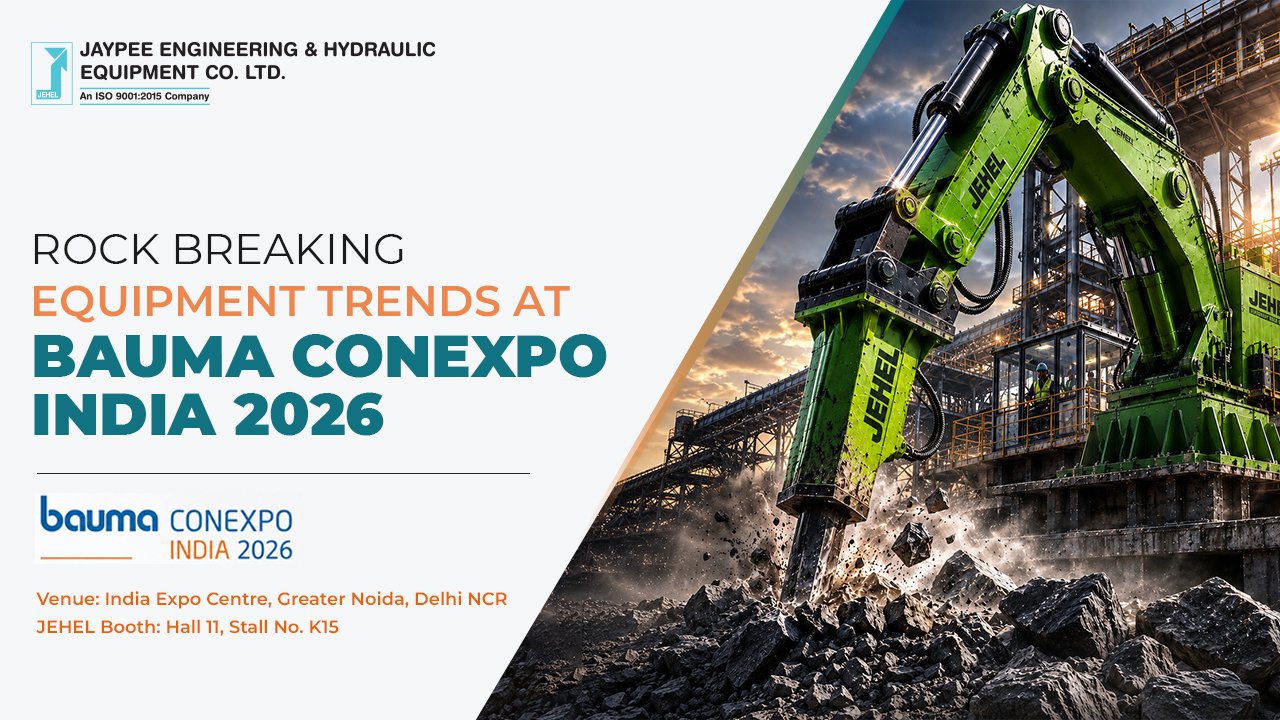
A crusher jam at a cement plant doesn’t announce itself politely. One oversized boulder lands on the grizzly, the jaw locks up, and everything downstream goes quiet. The conveyor stops. The bunker starts emptying. The kiln feed rate drops. All because one rock was too big. This is the problem that rock breaking equipment exists to solve, and the technology behind it is changing faster than most plant managers realise.
At bauma CONEXPO INDIA 2026 (15 to 18 September, India Expo Centre, Greater Noida), rock breaking equipment at bauma CONEXPO 2026 will be one of the more interesting categories on the floor. Not because the basic principle has changed. Boom, hammer, break the boulder. That part is the same. But the control systems, the operating modes, and the maintenance intelligence around these machines are evolving.
Here are the trends worth watching, and what they mean for your crusher operation.
Trend 1: Remote Operation Is Now Standard, Not Optional
Five years ago, remote pendant control on a stationary rock breaker was a premium feature. Today, it’s table stakes. No serious manufacturer should be offering an SRB that requires the operator to stand near the crusher mouth during breaking.
The current options are twofold. A wired or wireless remote pendant lets the operator control the boom from ground level, 15 to 30 metres from the crusher. An enclosed operator cabin near the crusher gives better visibility and weather protection for multi-shift operations.
When you’re evaluating a hydraulic rock breaker at bauma CONEXPO 2026, check whether remote operation is included as standard or sold as an add-on. That distinction tells you whether the manufacturer considers operator safety a core design element or an afterthought.
Trend 2: Semi-Autonomous Breaking Cycles
This is the frontier. Semi-autonomous rock breakers use sensors to detect when an oversized piece lands on the grizzly. The system identifies the boulder’s position, calculates the boom trajectory, and initiates a breaking cycle without waiting for a human command.
It’s not fully autonomous yet. The operator monitors and can override at any point. But the detection and positioning logic is already working in controlled environments. At bauma, expect to see early-stage versions of this capability from a handful of manufacturers.
For mines and coal handling plants running continuous shifts, this is significant. It means the rock breaker can respond to a grizzly blockage in seconds, not the minutes it takes for an operator to notice, assess, and act.
Trend 3: Condition Monitoring on the Boom and Hydraulics
A rock breaker boom takes a beating. The hammer strikes thousands of times per shift. The cylinder extends and retracts under high load. The pivot pins absorb shock on every impact. Knowing when these components are approaching failure, before they actually fail, is the difference between a planned maintenance stop and an emergency shutdown.
The trend here is built-in condition monitoring. Pressure sensors on the hydraulic circuit. Vibration sensors on the boom joints. Oil quality monitors on the power pack. All feeding data to a PLC or SCADA system that flags degradation early.
At the exhibition, ask manufacturers which monitoring points are included as standard and which require aftermarket installation. The ones who’ve designed it in from the beginning will have cleaner integration.
Trend 4: Compact Demolition Machines Entering the Rock Breaking Space
Traditionally, a stationary rock breaker works above the crusher, and a compact demolition machine works inside structures. But the line is blurring. Some plant operators are now using compact robotic breakers like the Boxer series for secondary breaking below the grizzly, or for clearing blockages inside hoppers and chutes where a pedestal-mounted SRB can’t reach.
This crossover application is worth understanding if you operate plants where the material flow includes confined spaces, narrow chutes, or underground hoppers. The same machine that strips kiln accretion during a shutdown can clear a hopper blockage during a running shift.
Trend 5: Better Metallurgy in Hammer and Chisel Tips
This one is quiet but impactful. The hammer tip is the consumable on a rock breaker. Its hardness determines how many strikes it can take before it needs replacing. Better heat treatment processes and alloy compositions are extending tip life significantly.
Ask exhibitors about their chisel tip material grade, heat treatment method, and expected replacement interval. A tip that lasts 30% longer than the competition’s saves you downtime, inventory cost, and maintenance labour across a year of continuous operation.
Where to See These Trends in Person
- Event: bauma CONEXPO INDIA 2026
- Dates: 15 to 18 September 2026
- Venue: India Expo Centre, Greater Noida, Delhi NCR
- JEHEL Booth: Hall 11, Stall No. K15
- Timings: 10:00 AM to 6:00 PM (Sep 15-17), 10:00 AM to 5:00 PM (Sep 18)
Why These Trends Matter Now
India’s mining and cement sectors are expanding. More crushers mean more grizzlies, and more grizzlies mean more oversized boulders that need breaking. The rock breaker isn’t going away. But the version you buy in 2026 should be meaningfully better than what was available even two years ago.
The exhibition is the best place to see these improvements firsthand. Spec sheets can describe a condition monitoring system. Only a booth visit lets you see how it’s actually integrated into the machine.
JEHEL will have its SRB series (SRB 4 through SRB 12.5) and Boxer demolition machines at Hall 11, Stall K15. To discuss your crusher configuration and rock breaker requirements before the event, reach out at +91 9051617609 or through jehel.com/contact.
SOURCES
- India construction equipment market USD 8.55 billion in 2025, 8.05% CAGR: mordorintelligence.com/industry-reports/india-construction-equipment-market
- bauma CONEXPO INDIA 2024 data (984 exhibitors, 135,000 sqm): bcindia.com/en/trade-fair/data/numbers/