Project managers frequently overlook the site preparation phase until it begins to delay the job at hand. Preparing the ground level for construction requires additional passes, more time and additional fuel than anticipated in the overall project schedule. The gap between what is planned and what is actually accomplished expands quickly if equipment is not matched appropriately to the work being done.
These consequences are easy to underestimate until they start showing up in the project budget. An unlevel site disrupts the work of subsequent trades, causes rework to accumulate, and allows undetected drainage issues to compound into costly corrections later in the project. Ultimately, these hidden costs will add up to a significant amount of the project budget for large-scale earthmoving.
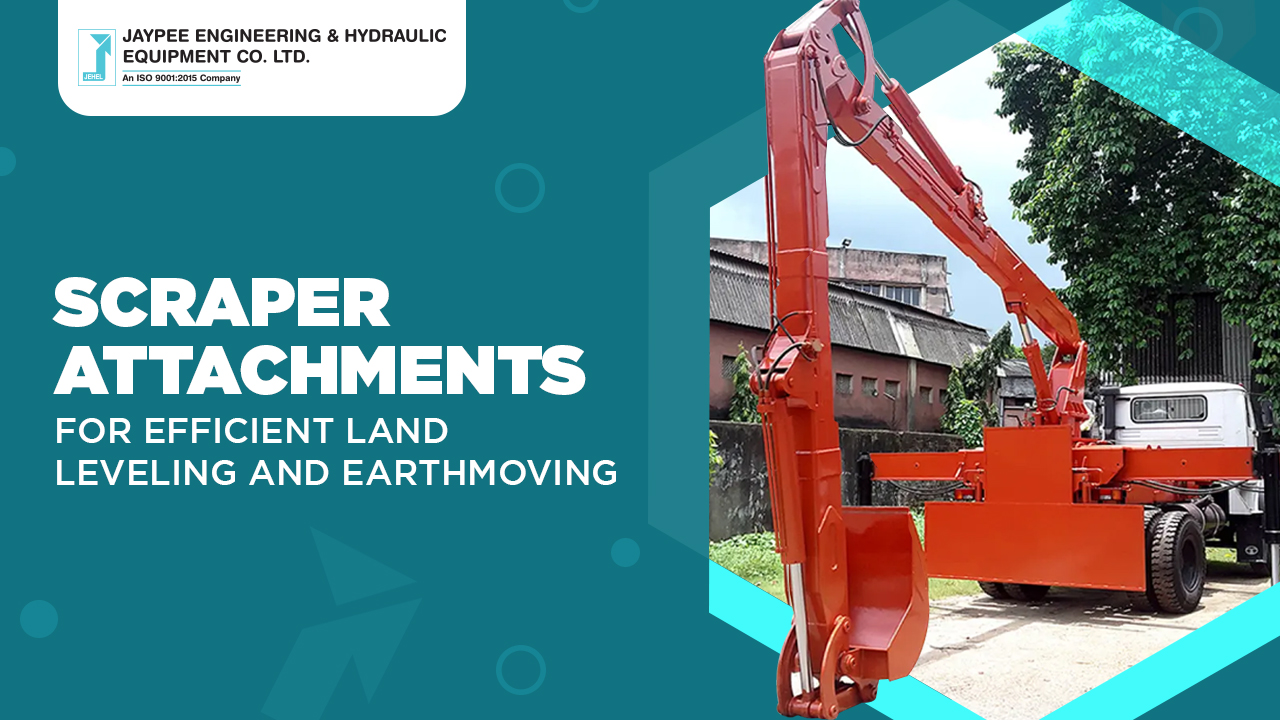
Land levelling scrapers have been around for many years; however, improvements in scraper attachments have increased dramatically over the past few years. Modern tractor scrapers use hydraulic technology to accomplish cutting, carrying, and spreading all in one pass, which means they are a very efficient option for bulk earthmoving and grading.
What a Scraper Actually Does Differently
A scraper differs from excavators and dozers in that it completes the entire excavation process in one continuous action. Scrapers create a cut in the ground, haul that cut to a designated fill location, and spread the fill at that fill location, all while in motion.
You save money by using only one piece of equipment rather than two or three to do the same job. On large projects, fewer pieces of equipment in the field also means less operational complexity, resulting in fewer machine hours and a lower fuel cost per cubic metre moved.
Where Scrapers Outperform Other Earthmoving Methods
Graders are great for finishing work, but they’re not good for moving bulk volumes. Excavators and dump trucks are great for deep cut-and-carry work, but you’ll need a number of them to keep up the throughput. The land levelling scraper occupies a different category entirely, designed for high-volume cut-to-fill work where haul distances are moderate, and ground conditions permit traction.
Agricultural land levelling, road subgrade prep, and large infrastructure platforms are all examples of work where a scraper attachment provides better cycle economics than any other combination of equipment.
Getting the Specification Right
Not all scrapers are designed for all sites. The bowl size, cutting edge geometry, and the available hydraulic force from the tractor all have to be matched to the volume and type of soil being moved. Heavy or rocky material demands a larger cutting edge and more hydraulic downforce. Loose or sandy material requires a different bowl depth to efficiently convey the material without dropping the load on transfer.
A common mistake is running an undersized scraper on heavy clay soils and compensating with extra passes. This negates the efficiency advantage and increases the wear on the cutting edge and the hydraulic cylinders.
The Numbers Behind the Shift to Mechanised Earthmoving
The global earthmoving equipment market is valued at USD 70.49 billion in 2025 and is projected to grow at a CAGR of 5.56% through 2033 (Source: Farmonaut), driven largely by infrastructure expansion and the increasing mechanisation of site preparation work across construction and agriculture. (Source: Straits Research, 2025)
Earthmoving equipment currently holds a 40.4% share of the heavy construction equipment market in 2025, with demand driven by site preparation, land grading, and large-scale excavation projects. Boom & Bucket (Source: Market Data Forecast, 2025)
These figures confirm what experienced site managers have observed for years. When bulk earthmoving is managed with the right attachment, project schedules compress, and cost-per-metre figures meaningfully decline.
Conclusion
The argument for scraper attachments is simple. Completing the same work in fewer passes, with less equipment and less fuel, will always produce better project economics. The principle holds across site types, whether it is an agricultural field, a road corridor, or a large industrial platform.
Across a project’s lifetime, the difference between a matched and an unmatched equipment fleet is measured not in hours alone, but in fuel consumption, maintenance intervals, and schedule adherence.
JEHEL‘s hydraulic equipment is built for the tough demands of heavy industry and site operations. For application-matched scraper solutions built to perform under heavy, sustained operational loads, JEHEL’s engineering capabilities include standard and custom-designed equipment.