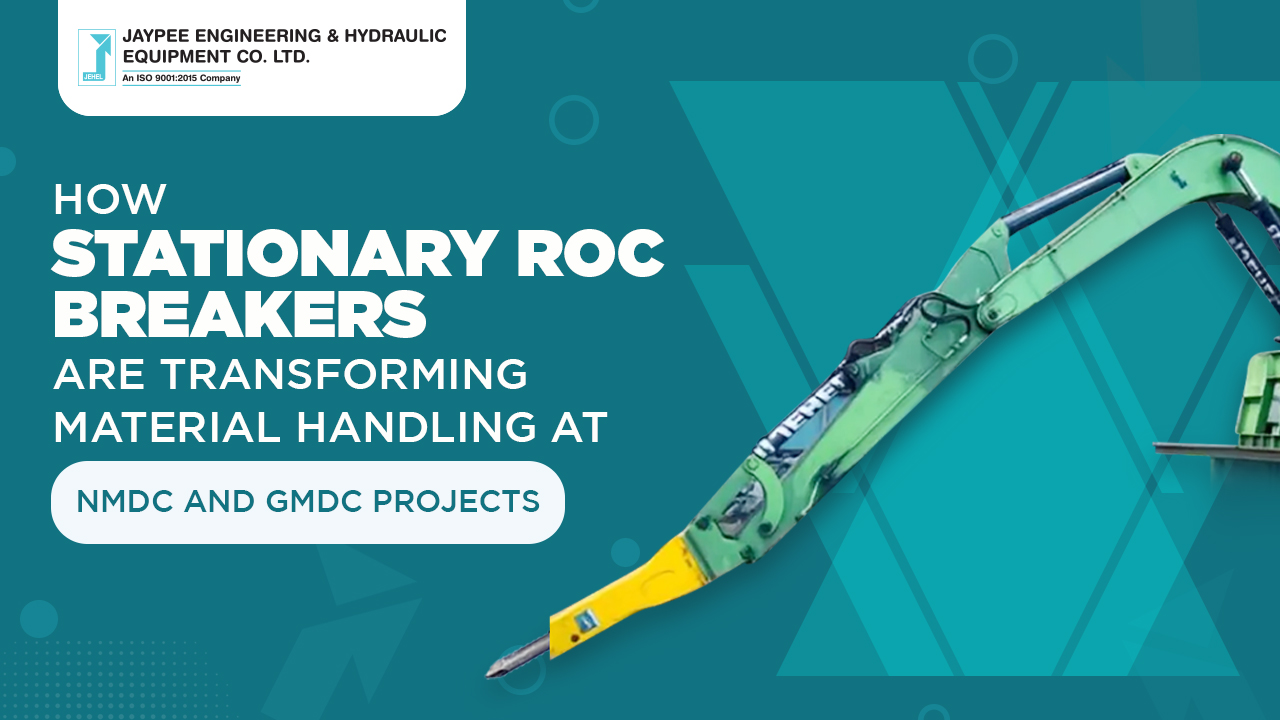
A decade ago, having a stationary rock breaker was seen as an option in the Indian mining industry. Currently, the scenario has drastically changed with the Stationary Rock Breaker playing an increasingly crucial role in NMDC’s iron ore operations in Bailadila and GMDC’s lignite projects in Gujarat. It is not a fashion statement but a result of economic viability.
Pressure is building. Coal production has touched its highest level with 1,047.52 million tonnes produced in FY 2024-25, as stated by the Ministry of Coal. India’s ambitious target is set to see the country produce a staggering 1.5 billion tonnes by 2029-30.
As for the steel capacity build-up, it is targeted to reach 300 MT by 2030, which would require massive tonnages of iron ore being mined. Such volumes will expose any weakness in the material handling chain, and large jams tend to be the most vulnerable.
It may come as quite a surprise to learn about the different solutions offered by Stationary Rock Breakers for problems faced in coal and iron ore mining.
The Iron Ore Challenge at NMDC-Scale Projects
Ores extracted from NMDC’s Bailadila mines are extremely tough and compact. Compression values greatly exceed those found in average coal seams. A “rock breaker for iron ore mining” requires an entirely different design compared to one for coal mining operations.
Tool steel quality, impact energy, and cylinder specifications will all need to be adjusted accordingly. If one uses a rock breaker meant for soft coal mining, it would be destroyed within a month in a haematite mine with superior grades.
There are some differences in the operation process, too. Iron ore grizzlies usually contain larger chunks of boulders, but fewer oversized events are encountered than with coal grizzlies.
The Lignite and Coal Picture at GMDC-Type Projects
The lignite mines and captive coal operations managed by GMDC have a duty cycle that is quite distinct from the rest. While the rock is easier to work with, it tends to yield a greater number of oversize rocks, which need to be removed regularly. This means that operators at such operations keep their breaker running continuously throughout the day.
This type of duty cycle requires a robust hydraulic power pack, improved cooling facilities, and maintenance schedules based on operating hours rather than months. The same breaker that works well at the iron ore project site will wear out seals quickly when operated ten times as often at a lignite mine.
What’s Actually Being Transformed
Across both mine types, three specific things are getting better when a stationary rock breaker is properly installed:
- Crusher availability: Oversize events no longer trigger full-stop shutdowns.
- Haul cycle predictability: Trucks don’t back up waiting for manual oversize clearing.
- Safety incident rates: Crews aren’t climbing on live grizzlies with jackhammers.
- Liner life: Crushers aren’t absorbing oversize impacts they weren’t designed for.
- Shift planning: Production managers can actually plan throughput, not react to breakdowns.
Why a Coal Breaker Can’t Just Move to Iron Ore
The worst purchasing decision that we have come across involves the use of the same “material handling rock breaker” in mines of two differing categories. This could be attributed to the similarity of their mounting, reach of boom, and control system. Their internal design could not be more dissimilar.
Breakers for iron ore mining require high-grade tool steel, large cylinders, and hammer impact energy proportionate to rock compressive strength. On the other hand, breakers used in coal and lignite mining require efficient duty cycle, cooling capabilities, and sealing properties more than anything else.
Conclusion
The evolution that is taking place at major mining operations in India does not involve any technological breakthroughs. The real difference lies in the way machines are designed in accordance with materials and accompanied by effective servicing.
Mining operations that want to expand their capacities or start a new one in the coming years can learn a valuable lesson from major players. Design the breaker according to your specific materials and working cycles, and don’t forget that quality service will always be more important than brand.
When looking for a stationary rock breaker for your mining project, connect with JEHEL about your rock type, grizzly size and work cycles to receive the optimal configuration for your mining operation.