
Hydraulic machines are at the heart of modern industry — from the hydraulic crane towering over a construction site to the precision brakes in your car. If you’ve ever searched for what is a hydraulic machine, how hydraulic machine working principles operate, or what types of hydraulic machines exist, you’re in the right place.
This comprehensive guide covers the definition of hydraulic machines, their working principles (including Pascal’s Law), the major types of hydraulic machines and their uses, and real-world applications of hydraulic machines across construction, manufacturing, and more.
What Is a Hydraulic Machine? Definition and Meaning
A hydraulic machine is a mechanical system that uses fluid power — typically pressurized oil or water — to transmit force and perform useful work. The word ‘hydraulic’ comes from the Greek hydor (water) and aulos (pipe), reflecting how these machines channel fluid energy into mechanical motion.
Hydraulic Machine Definition
In engineering terms, the hydraulic machine definition refers to any device that converts hydraulic (fluid) energy into mechanical energy, or vice versa. This includes machines that generate pressure (hydraulic pumps), machines that use pressure to create motion (hydraulic cylinders and motors), and hybrid systems.
Hydraulic Machine Meaning in Industry
The hydraulic machine meaning extends beyond a simple textbook definition. In practical industry, it represents a class of equipment that offers unmatched power density — the ability to move enormous loads with precision, using relatively compact components. This is why hydraulic machinery and equipment is standard across heavy industries worldwide.
📌 Key takeaway: Hydraulic machines work by applying pressure to a confined fluid, which transmits force to actuators that perform mechanical work.
How Does a Hydraulic Machine Work? Working Principle Explained
Pascal’s Law: The Foundation
The working principle of hydraulic machines is rooted in Pascal’s Law, which states: pressure applied to a confined fluid is transmitted equally in all directions throughout the fluid. This principle, discovered by mathematician Blaise Pascal in 1647, is what allows a small force to generate a much larger output force.
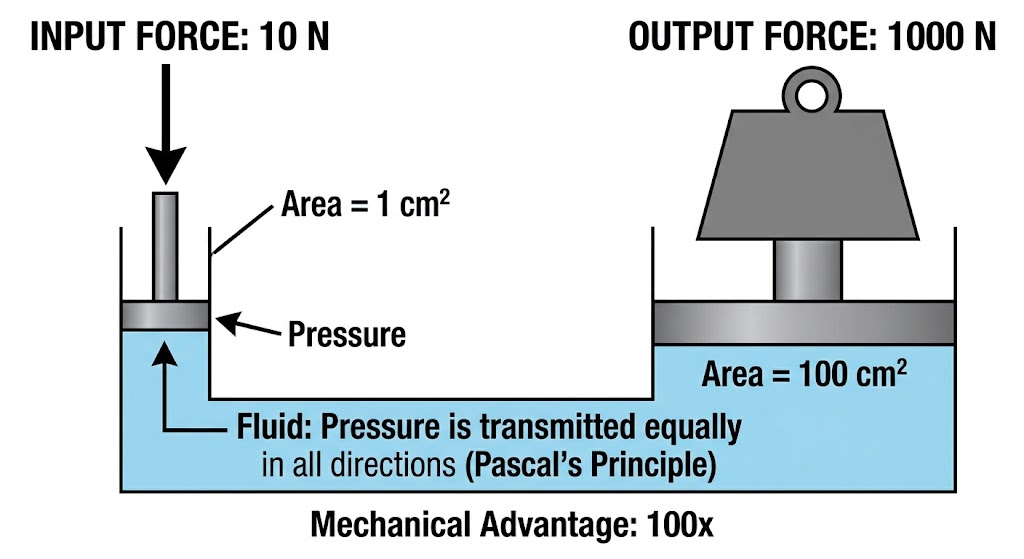
The classic hydraulic press example: If a force of 10 N is applied to a small piston with an area of 1 cm², the pressure (10 N/cm²) is transmitted equally to a large piston with an area of 100 cm². The output force becomes 1,000 N — a 100× mechanical advantage.
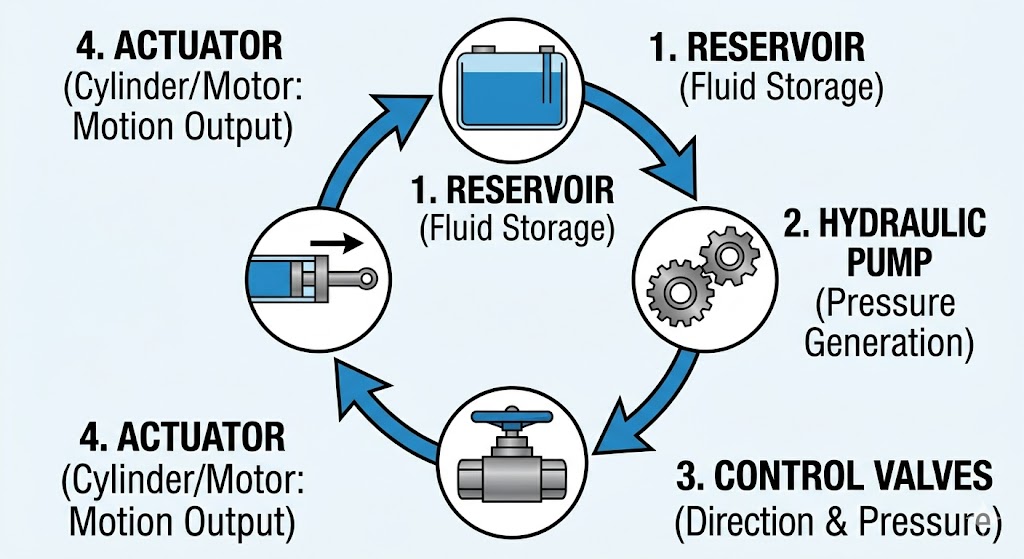
The Hydraulic Machine Working Process — Step by Step
- The reservoir stores hydraulic fluid (usually oil).
- The hydraulic pump draws fluid from the reservoir and pressurizes it.
- Pressurized fluid travels through lines and hoses to control valves.
- Valves direct flow to the actuator (cylinder or motor).
- The actuator converts fluid pressure into mechanical force or rotation.
- Used fluid returns to the reservoir via return lines.
Role of Hydraulic Fluid
Hydraulic fluid is the lifeblood of the system. It serves three critical roles: transmitting pressure (power medium), lubricating moving components (reducing wear), and acting as a coolant (carrying heat away from actuators). The hydraulic machine working depends heavily on fluid viscosity, cleanliness, and thermal stability.
Key Components of a Hydraulic System
- Reservoir: Stores and conditions the hydraulic fluid
- Pump: Converts mechanical energy to hydraulic pressure
- Valves: Regulate flow direction, pressure, and volume
- Actuators: Convert hydraulic energy to mechanical work (cylinders/motors)
- Filters & Seals: Maintain fluid cleanliness and prevent leaks
Want to see how this system powers a real machine? Learn about the hydraulic truck tippler mechanism for a detailed real-world example.
Types of Hydraulic Machines and Their Uses
Understanding the types of hydraulic machines helps you select the right solution for your application. Here is a classification of hydraulic machines by function:
1. Hydraulic Pumps
Hydraulic pumps convert mechanical energy (from an electric motor or engine) into fluid pressure. They are the power source of every hydraulic system.
- Gear Pumps: Simple, reliable, cost-effective; ideal for constant flow applications
- Piston Pumps: High efficiency, suitable for high-pressure heavy-duty tasks
- Vane Pumps: Smooth operation, low noise, suited for precision equipment
Jehel’s Power Pack integrates pump technology with the control systems needed for industrial material handling.
2. Hydraulic Motors
Hydraulic motors do the reverse of pumps — they convert fluid pressure into rotational mechanical power to drive machinery and equipment.
- Gear Motors: Compact and cost-effective for space-limited applications
- Vane Motors: Smooth, low-noise operation for precision equipment
- Piston Motors: High power density for heavy-duty applications
3. Hydraulic Cylinders
Hydraulic cylinders produce linear force from fluid pressure. A piston inside a sealed cylinder extends or retracts when pressurized fluid enters. They are used in everything from construction equipment to industrial presses.
Jehel’s double-acting cylinder design takes this a step further — learn why Jehel’s double-acting cylinder tippler design offers superior efficiency compared to conventional designs.
4. Hydraulic Cranes
Hydraulic cranes use cylinders and motors to lift, swing, and lower heavy loads with precision. The hydraulic crane is a core piece of equipment in construction, ports, and material handling — combining reach, load capacity, and fine positional control.
See also: How Hydraulic Cranes Enhance Heavy Lifting
5. Hydraulic Grabs and Attachments
Hydraulic grab attachments extend the capabilities of base machines (cranes, excavators) for specialized material handling:
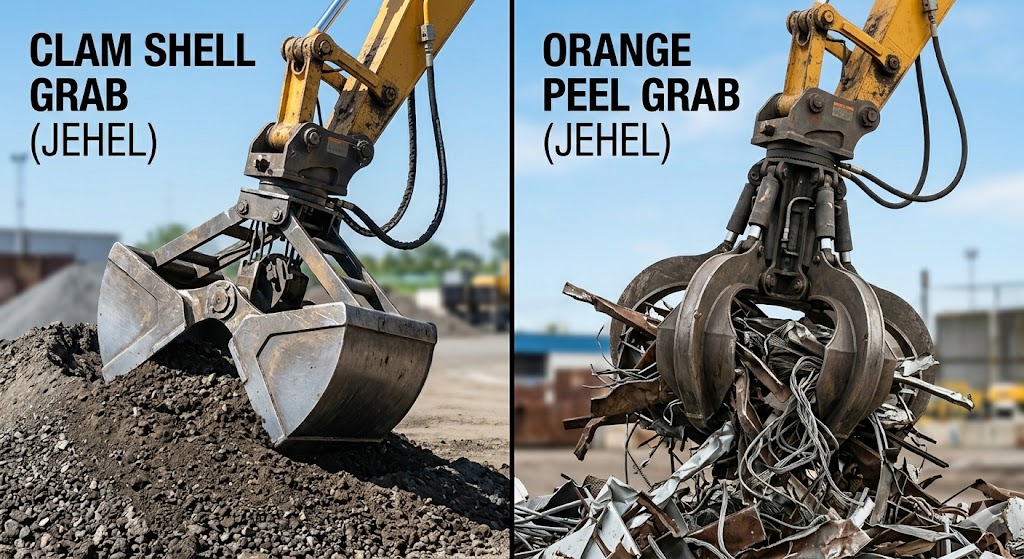
- Clam Shell Grab — for bulk material handling and excavation
- Orange Peel Grab — for scrap metal, waste, and loose material handling
- Stationary Log Grabber — for timber yards and forestry operations
- Mobile Log Grabber — for flexible log handling across sites
Read more: Clamshell vs Orange Peel Grabs — Selecting the Right Tool for Bulk Material Handling
6. Hydraulic Breakers and Rock Breakers
Hydraulic breakers use rapid hammer action powered by hydraulic fluid to fracture rock, concrete, and hard materials. The stationary rock breaker and the JP Rok series are specialized hydraulic machines for quarrying, mining, and kiln maintenance — delivering the principle of hydraulic machine force in percussive, high-impact form.
Learn more: Hydraulic Rock Breaker for Mining and Crushing Lines
7. Hydraulic Truck Tipplers
A hydraulic truck tippler uses hydraulic cylinders to tilt entire trucks, enabling rapid unloading of bulk materials like coal, sand, and grain. This is a leading application of hydraulic machine uses in logistics and heavy industry.
Compare: Hydraulic vs Mechanical Truck Tipplers — Key Differences Explained
Applications of Hydraulic Machines Across Industries
The applications of hydraulics span virtually every industrial sector. Below are the major uses of hydraulic machines with real-world context.
Construction Industry
Hydraulic machinery is the backbone of construction. Hydraulic excavators, bulldozers, cranes, and piling rigs all rely on hydraulic systems for their power. The precision of hydraulic machine working allows operators to perform both high-force tasks (moving earth) and delicate tasks (positioning formwork) with the same equipment.
Jehel’s Mini-Mobile Breaker and Excavator (Boxer) demonstrates how compact hydraulic machines are revolutionizing urban demolition and confined-space construction work.
See: Beyond the Jackhammer: How Demolition Robots Are Changing Safety in Construction
Mining and Quarrying
In mining, hydraulic devices handle the toughest jobs — breaking rock faces, moving ore, and supporting tunnel structures. Hydraulic pedestal rock breaker boom systems are permanently mounted above crushers to clear blockages without halting operations.
Related: Advantages of Stationary Rock Breakers in Heavy Industries
Manufacturing and Industrial Processing
Hydraulic presses, shears, and forming machines are central to metal fabrication, plastics manufacturing, and food processing. The consistent force and fine control of hydraulic machine working principle makes them ideal for stamping, forging, and injection moulding.
The Bundling Press and Container Tilter from Jehel exemplify how hydraulic machines optimize factory floor productivity.
Forestry and Timber
Log handling is one of the most demanding uses of hydraulic machines in terms of both load weight and operational repetition. Stationary log grabbers and mobile log grabbers use hydraulic circuits to grip, lift, and maneuver timber safely and efficiently.
Deep dive: Log Grab Technology for Forestry Efficiency
Waste Management and AFR Handling
Alternative Fuel and Raw Material (AFR) handling is a growing application of hydraulic machines in the cement and energy sector. Hydraulic grabs and booms handle refuse-derived fuel (RDF), biomass, and mixed industrial waste with the agility needed in fast-paced processing environments.
Explore: The Role of AFR Handlers in Sustainable Waste Management
Automotive Industry
Hydraulic machines are embedded in every modern vehicle. Hydraulic brakes use Pascal’s Law to multiply pedal force across all four wheels. Power steering systems use hydraulic pressure to reduce steering effort. Even most automatic transmissions use hydraulic control circuits.
Classification of Hydraulic Machines
A standard classification of hydraulic machines divides them into two broad categories:
Turbomachinery (Dynamic Hydraulic Machines)
These machines continuously exchange energy with the fluid via rotating components (impellers, runners). Examples include centrifugal pumps and hydraulic turbines. Energy transfer occurs through changes in fluid velocity.
Positive Displacement Machines
These machines trap and displace fixed volumes of fluid per cycle. They include gear pumps, piston pumps, and vane pumps. They provide precise, controllable flow regardless of pressure changes — making them preferred for industrial hydraulics.
Note: Most hydraulic machinery and equipment in industrial settings — including all Jehel products — uses positive displacement hydraulics for its precision and high-pressure capability.
Hydraulic System Definition and Key Terminology
A hydraulic system definition encompasses all the components that work together to generate, control, and apply fluid power. Here are the key terms for anyone studying or working with hydraulic machines in fluid mechanics:
- Hydraulic system: The complete assembly of pump, valves, actuators, fluid lines, and reservoir
- Pascal’s Law: Pressure in a confined fluid is transmitted equally in all directions
- Flow rate: Volume of fluid moving per unit time (litres/min), determines speed of actuators
- Working pressure: The operating pressure of the system (bar or PSI)
- Actuator: A cylinder or motor that converts hydraulic energy to mechanical work
- Power pack: A self-contained hydraulic unit combining pump, motor, reservoir, and controls
See Jehel’s Hydraulic Power Pack — Components and Functionality for a practical breakdown of how these systems are assembled.
Advantages of Hydraulic Machines
Why do industries worldwide rely on hydraulic machinery? Here’s what makes hydraulic systems the preferred choice for high-power applications:
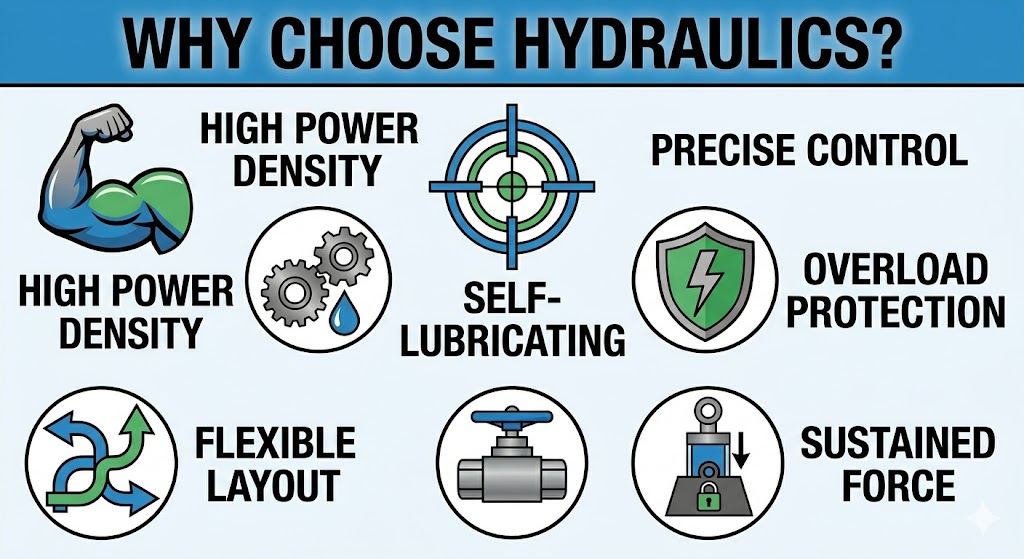
- High power density: Hydraulic systems produce more force per unit size than mechanical or pneumatic alternatives
- Precise control: Valves allow fine regulation of speed, position, and force
- Self-lubricating: The hydraulic fluid lubricates components, reducing maintenance
- Overload protection: Relief valves protect the system from pressure spikes
- Flexible layout: Lines and hoses can route power around obstacles, unlike rigid mechanical linkages
- Sustained force: Hydraulic systems maintain force without continuous energy input (holding loads statically)
These advantages make stationary hydraulics and mobile hydraulic systems indispensable across industries.
Maintenance of Hydraulic Machines
Proper maintenance ensures long life and reliable hydraulic machine working. Key maintenance practices include:
- Regular fluid analysis — check for contamination, viscosity changes, and water ingress
- Filter replacement — hydraulic filters should be changed on schedule, not just when blocked
- Seal inspection — worn seals cause internal and external leaks, reducing efficiency
- Temperature monitoring — overheating degrades fluid and damages seals
- Hose and fitting inspection — check for abrasion, kinks, and loose connections
Read: When to Repair vs Replace — A Guide for Your Hydraulic Breaker Maintenance
The Future of Hydraulic Machines
Smart Hydraulics and IoT Integration
Modern hydraulic systems increasingly incorporate smart sensors, IoT connectivity, and predictive maintenance software. Pressure transducers, flow meters, and temperature sensors feed data to monitoring platforms, enabling operators to detect issues before failure occurs — reducing unplanned downtime significantly.
Electro-Hydraulic Hybrid Systems
Electro-hydraulic actuators (EHAs) combine electric motors with hydraulic components, offering the precision of electric drives with the power density of hydraulics. This is a major direction for hydraulic machine working in aerospace, mobile equipment, and renewable energy applications.
Sustainable Hydraulic Fluids
Biodegradable and fire-resistant hydraulic fluids are replacing conventional mineral oils in environmentally sensitive and high-temperature applications. These eco-friendly alternatives maintain performance while reducing environmental risk.
AI-Powered Hydraulic Control
Artificial intelligence is being applied to hydraulic systems for adaptive control — automatically adjusting pressures, flow rates, and valve timing based on real-time operating conditions. This represents the next generation of hydraulic system definition in smart factories.
Related: Future of Excavator Attachments — Strength and Efficiency
Examples of Hydraulic Machines in Everyday Life
Wondering about examples of hydraulic machines you encounter regularly? Here are some machines that use hydraulics in everyday contexts:
- Car braking systems (hydraulic disc brakes)
- Power steering in vehicles
- Hydraulic car lifts at service stations
- Aircraft landing gear and flight control surfaces
- Elevator systems in buildings
- Garbage collection trucks (compaction mechanism)
- Dental chairs (height adjustment)
- Construction excavators and loaders
In industrial settings, things that use hydraulics range from the scissor lift in a warehouse to the basket boom on a utility vehicle.
Jehel’s Range of Hydraulic Machines and Equipment
Jehel (Jaypee Engineering & Hydraulic Equipment Company Limited) designs and manufactures specialized hydraulic machinery and equipment for material handling, rock breaking, and bulk unloading. Based in Kolkata, India, Jehel’s products serve construction, mining, cement, ports, and forestry sectors across India and internationally.
Jehel’s product range includes:
Hydraulic Truck Tippler — Bulk unloading of trucks for coal, sand, and aggregates
Stationary Rock Breaker — Fixed installation for crusher hopper clearing
JP Rok — Kiln accretion removal system for cement plants
Hydraulic Crane — Heavy lift cranes for industrial applications
Clam Shell Grab — Bulk material grabbing for cranes and excavators
Orange Peel Grab — Scrap and waste material handling
Mini-Mobile Breaker (Boxer) — Robotic demolition in confined spaces
Scissor Lift — Personnel and material lifting platform
Snow Plough — Hydraulically operated snow clearing attachment
AFR Handling Boom — Alternative fuel handling for cement plants
Scrapper — Floor and road scraping attachment
Power Pack — Standalone hydraulic power unit
For further reading on how these machines perform in the field, explore Hydraulic Excellence — Insights from Jehel or the comprehensive overview at Power, Precision, and Versatility of Hydraulic Machines.
Frequently Asked Questions About Hydraulic Machines
What is hydraulic machine meaning in simple terms?
A hydraulic machine is any device that uses pressurized liquid (usually oil) to transmit force and do work. The liquid cannot be compressed, so pressure applied at one point travels instantly to another point in the system.
What is the working principle of hydraulic machine?
Hydraulic machines work on Pascal’s Law: pressure applied to a confined fluid is transmitted equally in all directions. A pump pressurizes the fluid; valves direct it; actuators (cylinders or motors) convert that pressure back into mechanical force or movement.
What are the main types of hydraulic machines?
The main types include hydraulic pumps (gear, piston, vane), hydraulic motors, hydraulic cylinders, hydraulic cranes, rock breakers, truck tipplers, and grab attachments (clamshell, orange peel). Each type serves different applications of hydraulic machines.
What is the definition of hydraulic machine?
The definition of hydraulic machine: a system that uses fluid under pressure to generate, transmit, and control power. It converts mechanical energy to hydraulic energy (pump) or hydraulic energy to mechanical energy (actuator).
What are examples of hydraulic machines?
Examples include hydraulic excavators, car brakes, power steering systems, hydraulic presses, elevators, aircraft landing gear, garbage truck compactors, and industrial equipment like hydraulic cranes and truck tipplers.
What are the uses of hydraulic machines?
Uses of hydraulic machines span construction (excavation, lifting), mining (rock breaking), manufacturing (pressing, forming), transport (tipping, unloading), forestry (log handling), waste management (AFR handling), and automotive (braking, steering).
How do hydraulic machines work?
How hydraulic machines work: a pump generates fluid pressure; control valves direct the pressurized fluid to an actuator; the actuator converts pressure to mechanical force (cylinder) or rotational power (motor); return fluid goes back to the reservoir to repeat the cycle.
Conclusion
Hydraulic machines — from the simplest hydraulic cylinder to a complex hydraulic truck tippler — are indispensable to modern industry. Their power, precision, and versatility stem from a beautifully simple principle: fluid under pressure obeys Pascal’s Law, enabling force multiplication, precise control, and flexible power transmission across enormous distances.
Whether you’re searching for the definition of hydraulic machine, understanding the working principle of hydraulic machine for an exam, or evaluating hydraulic machinery and equipment for your facility — the answer is the same: hydraulic systems remain the most reliable, high-density power transmission technology available.
To explore Jehel’s range of purpose-built hydraulic machines or discuss a custom solution for your operation, contact the Jehel team today.
Related Articles
- Hydraulic vs Mechanical Truck Tipplers — Key Differences Explained
- Hydraulic Pedestal Rock Breaker Boom Systems
- Clamshell vs Orange Peel Grabs — Selecting Tools for Bulk Material Handling
- How Hydraulic Grabs Outperform Mechanical Grabs in Efficiency and Control
- Hydraulic Power Pack — Components and Functionality
- The Role of AFR Handlers in Sustainable Waste Management
- How Mini-Mobile Breakers Increase Flexibility of Excavators