Imagine a 400-tonne haul truck unloading its payload into the hopper of a primary crusher when an oversize rock jams the grizzly. Production comes to a halt, not only of the crusher but of the entire conveyor belt system as well, while a production supervisor in the control room watches the tonnage count per hour go up in smoke. Such occurrences are frequent in open-pit mining and come with their fair share of losses.
Global open-pit mining is expected to have a CAGR of 6.1% from 2022 to 2032, growing to about USD 224 billion [1]. Increased mining production around the world puts increasing pressure on crusher systems. A mining rock breaker system that can be mounted inside the hopper has therefore become indispensable in recent years.
In this article, we will explore how a stationary rock breaker in mining helps improve the efficiency of an open-pit site. We’ll also explain why conventional practices are no longer enough, as well as what to look for in a reliable stationary rock breaker manufacturer.
Why Oversized Material Is the Biggest Productivity Killer
All open-pit operations encounter oversized rocks. Blasting does not always yield uniformly sized material, and geological surprises can be completely unexpected. When the oversized rocks cannot pass through the grizzly and land in the hopper, the only available way to crush them is by manual rock breaker using either a drop ball or an excavator hammer.
However, both options are slow and inefficient, while being risky for the employees involved. By shifting an excavator from its mining operations to handle just one oversized rock, two mining tasks will be halted. In turn, dropped balls need to have certain safety precautions and pose a danger due to the risk of dropping objects.
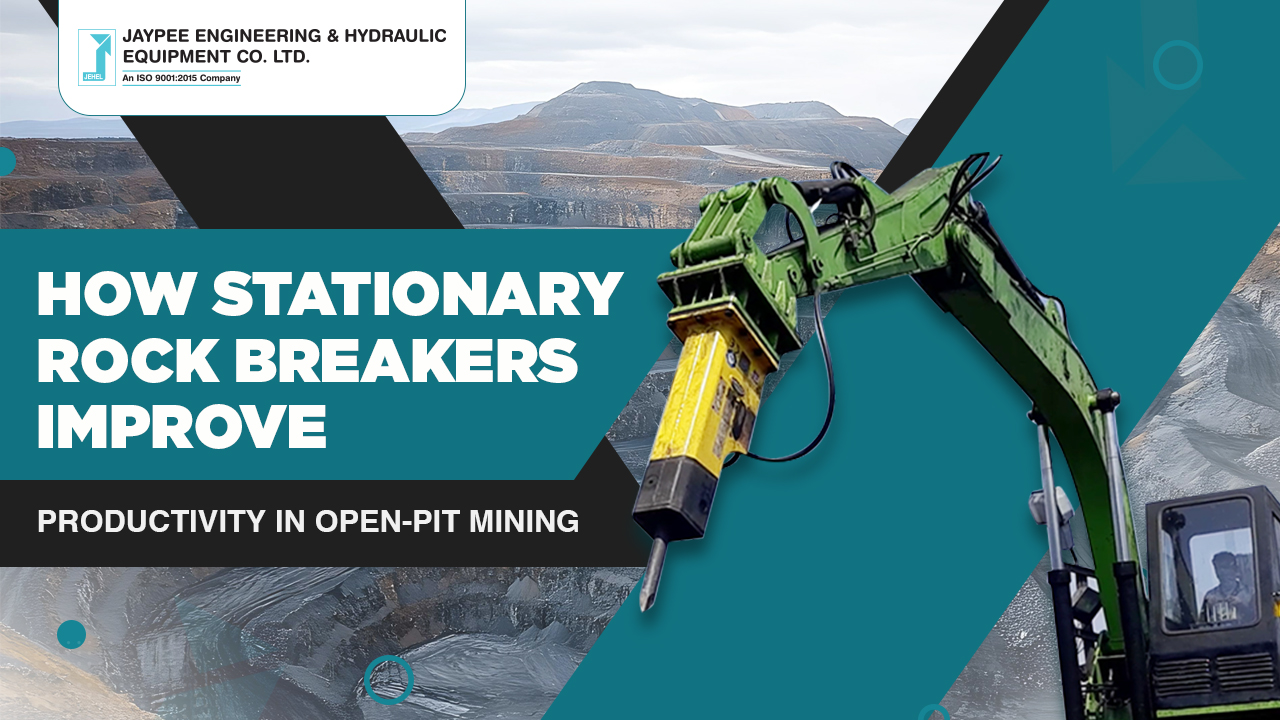
A hydraulic rock breaker mining system mounted on a pedestal boom next to the hopper solves this issue efficiently. The mechanism works independently, crushes oversized rocks quickly, and allows further processing of the crushed material while not disturbing other mining operations.
How a Pedestal Rock Breaker System Works at the Hopper
A pedestal rock breaker mining system consists of an articulated arm that is hydraulically driven and mounted on a pedestal. It is located next to the hopper of the primary crusher and has the capacity to turn 170 to 360 degrees around its column.
Upon placing the oversized rock on the grizzly, the operator will drive the arm from a separate cabin or control room. The breaker hammer is aimed at the rock, breaks it into sizes that will fit inside the primary crusher, and rakes away the fragmented material through the grizzly bars.
- Covers the entire hopper area with full rotational reach
- Operates independently of the mobile mining fleet
- Handles coal, limestone, iron ore, and hard rock formations
- Reduces manual intervention and exclusion zone requirements
Regarding the use of a rock breaker for open-pit mining, this stationary arrangement is best suited due to the constant position of the crushing station. No adjustments have to be made on an hourly basis.
Measurable Productivity Gains on the Ground
Three figures define the productive justification for a stationary rock breaker in mining: availability, cycle times, and throughput. With fewer hopper jams, the availability of the crusher is increased. Once the availability of the crusher increases, there will be no truck queues before the dumping site. In other words, shorter queues result in increased truck loads per shift.
Epiroc, together with Hancock Iron Ore, introduced an unprecedented concept back in 2026 at the Roy Hill iron ore mine in Australia. Specifically, 78 trucks were autonomously controlled during the project [3].
The important lesson learned from the experiment was that to increase productivity in open-pit mines, every possible bottleneck should be addressed along the chain, from the face to the crusher. A mining rock breaker system is perhaps the most economically efficient way to eliminate those bottlenecks in the material chain.
The operators of crushing units who equipped their installations with hydraulic rock breaker mining have testified to reduced downtime and lower wear of the grizzly bars.
Iron Ore, Limestone, Coal: Versatility Across Commodities
Open-pit mining uses different minerals, each requiring different fragment sizes. A rock breaker for iron ore mines is designed to work with hard lumps that do not break easily. In limestone mines, the rock breaker has to work with lumpy fragments bridging over the grizzly bars. In coal mines, there are soft but bulky oversize rocks blocking the hopper throat.
An industrial rock breaker is designed to be flexible enough to tackle all these different cases. It is possible to change the length of the boom, the hammer energy class, and how the rock breaker is mounted depending on the characteristics of the hopper and minerals. It is important to get a stationary rock breaker manufacturer.
What to Look for in an Industrial Rock Breaker Solution
Not all stationary rock breaker units are built the same. Before you invest, consider these factors:
- The boom reach must cover the entire hopper surface, including corners
- The hydraulic power pack should match the hardness of your primary material
- 360-degree rotation is essential for larger hoppers with multiple dump points
- Remote operation capability improves safety and response time
- After-sales service network with engineers who can reach your site quickly
A boulder breaking system in mining only delivers value if it’s engineered for your specific site. Customised solutions consistently outperform off-the-shelf models in field performance.
Explore how stationary rock breaker systems improve crushing efficiency in large-scale OCP operations by reducing hopper blockages and maintaining continuous material flow.
Conclusion
Open-pit mining is all about volumes. Any idle minutes of the crusher translate to lost tonnes, which, in turn, impacts the whole process chain. An oversized rock breaker in mining not only removes blockages but ensures there won’t be any in the first place.
With mining heading towards increased automation and heightened performance standards in 2026, the basics remain vital. Barrick Mining saw an impressive 61% increase in its net income for Q1 2025, owing mainly to solid open-pit mining [2]. All the automation, efficient blasting procedures and even advanced AI-based fleet management cannot help much, should a single oversized rock cause a stoppage of the crushing equipment.
JEHEL (Jaypee Engg. & Hydraulic Equipment Co. Ltd.) creates and installs custom stationary rock breaker solutions for open pit mining projects. Equipped with its own Research and Development department, 25 field service engineers, and with projects around India and abroad, JEHEL will definitely become a reliable solution provider for companies looking for reliable oversized rock breaker solutions.